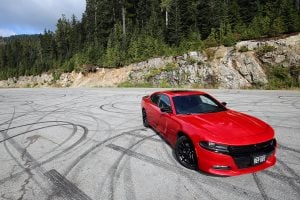


At a time when cars look and sound increasingly alike and automated systems are slowly replacing drivers, the 2018 Dodge Charger SRT Hellcat feels like a throwback to another era. It’s a full-size, four-door sedan with roots stretching back to the DaimlerChrysler days, rear-wheel drive, and a supercharged V8 that makes a ridiculous 707 horsepower. In a market increasingly dominated by SUVs, the Hellcat is something of an outlier, putting cubic inches and quarter-mile times ahead of just about everything else. But after spending time behind the wheel in and around Los Angeles, it became clear that all this straight-line muscle comes with a few compromises.
Related – 2026 Dodge Charger R/T Plus Review
What’s New for the 2018 Dodge Charger SRT Hellcat?

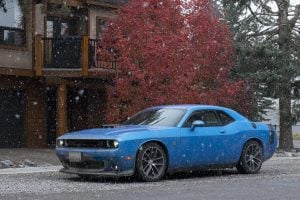
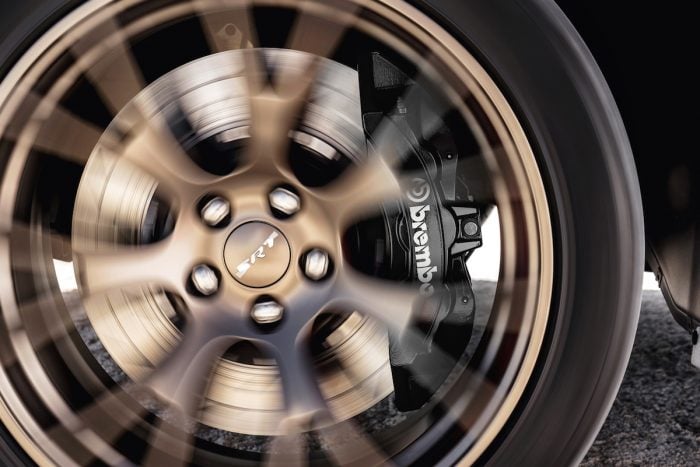
All 2018 Chargers get a Parkview rear back-up camera and Parksense rear park assist as standard. Our car’s subtle F8 Green is one of two new exterior colors along with IndiGO Blue. The beautiful Brass Monkey bronze wheels of the test machine (US$995, C$695) are also available on the SRT 392 as of 2018.
Other cosmetic upgrades to the Hellcat include new badging for the grille, fender and instrument panel (IP), a new Matte Vapor wheel finish option, optional black, orange and gunmetal brake calipers, available ‘Demonic Red’ Laguna leather interior and optional dual gunmetal grey stripes.
Lots of people loved F8 Green. Even in eco-conscious California, no one hated it, complained at the noise or shouted the kind of abuse that you might get in response to a more ostentatious ride. Pretty much everybody it seems, loves the Hellcat.
The important stuff is unchanged. Under the hood is the same 707-horsepower Hemi, making the Hellcat the world’s most powerful 4-door sedan. Rear-wheel drive, an 8-speed automatic transmission, Pirelli tires, Bilstein dampers and Brembo brakes are among the other ingredients of a family-sized vehicle that’ll hit 60mph in under four seconds and wake the neighbors every time you fire it up.
Comfortable Cruising, But Not Quite Luxury
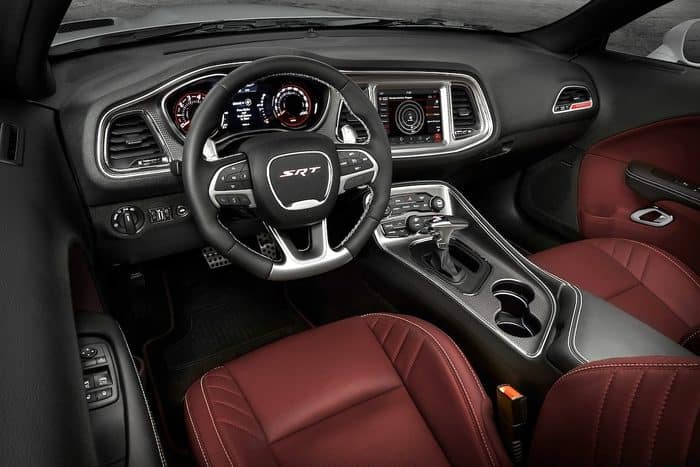
Dodge interiors have come a long way in 10 years and in the Hellcat, more work has been put in to try to create a premium ambience befitting of a US$66,295 (C$78,695) hot rod. Overall, it doesn’t hit the luxury heights of German performance sedans but it’s attractive, distinctive and leaves you in no doubt that this is an SRT machine. Only minor touches betray the Charger’s workaday origins, like the cheap-feeling trunk lid and its undamped opening mechanism.
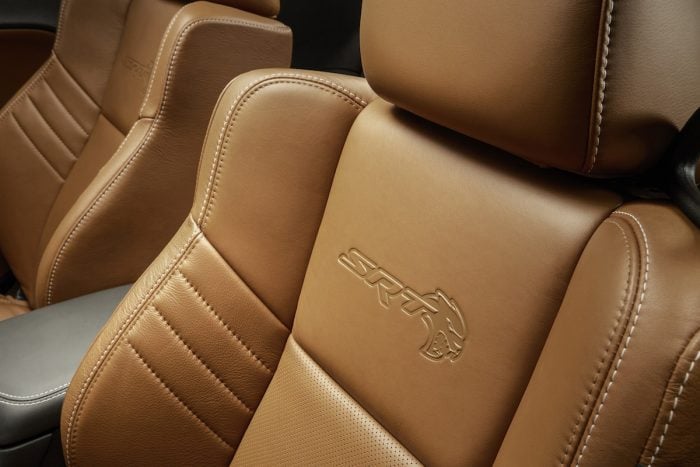
The Charger’s front doors open a long way, which makes it easy to get in and out but, unless you’re Mr Tickle, hard to shut the door once seated. The seats themselves are big, soft and comfortable performance armchairs with heating, ventilation and lots of power adjustment. Their high-set position is appropriately more NASCAR than low-set European racer.
Forward visibility, especially when parking, is a little compromised by the huge power bulge that accommodates two heat extractors. Otherwise the view around is good and the new parking assistance tech works well.
The leather-trimmed steering wheel feels suitably chunky and the instrument panel is FCA’s familiar, reconfigurable, digital item. The standard Uconnect infotainment system was enhanced on the test car by a US$1,995 (C$1,500), 19-speaker Harman Kardon upgrade that sounds terrific to my non-expert ears.
Related – New Dodge Charger Daytona Interior Channels Its Inner Sports Car
707 Horsepower, But Can the Chassis Keep Up?

- Engine: 6.2L supercharged HEMI V8
- Horsepower: 707 hp
- Torque: 650 lb-ft
- Transmission: 8-speed automatic
- Drivetrain: Rear-wheel drive
- 0–60 mph: 3.7 seconds (tested)
- Top speed: 204 mph (328 km/h)
And so to the road. The overriding impression of the Hellcat on the move is that the engine dominates the car, for good and bad. First the good. The Hellcat was conceived to go very fast in a straight line. It does, obviously, but care is required as it’s easy to break traction even on part throttle thanks to 650 lb-ft of torque driving the rear wheels alone. Acceleration is ferocious, and not just from rest, with more overtaking shove on tap than just about anything else out there.
There’s an appealing, old-fashioned whine to the supercharger as it spools up to accompany the Hemi’s exhaust bark. A Jaguar engineer once told me that supercharger whine was now regarded as an error state and that they’d worked to eliminate it. The SRT engineers clearly take a different view, and a good thing too.
When the Chassis Starts Fighting Back
The problem, for this reviewer at least, is that the chassis is forever fighting with the engine for control of the car, despite the sophisticated, adaptive suspension. Engine-induced shake is pretty uncommon above idle speeds in modern cars but it’s pronounced as you rumble along in the Hellcat. Add some steering into the mix – even a long, gentle, freeway bend at normal cruising speeds – and the car refuses to settle, always jiggling around instead of giving you the feeling of planted security.
There’s more, unfortunately. On uneven surfaces there’s head toss – a phenomenon that’s exactly what it sounds like, when you feel your head being thrown from side to side – and the admittedly punishing freeways around Los Angeles sometimes threw the damping into a tailspin. Over sections where the bumps and dips across the carriageway come thick and fast, the Hellcat once again won’t settle down, still dealing with the previous event even as you hit the next one. This was a problem with the Charger Scat Pack I drove on the same roads a couple of years back, and it remains an issue today.
In its defence, the ride on those gorgeous 20-inch forged rims and big P Zero summer tires (US$595, C$695) is never harsh and the Hellcat is surprisingly quiet and supple in the cruise. Even the fuel consumption isn’t too awful by supercharged V8 standards, hitting an EPA figure of 22 mpg on the highway and 16 mpg overall.
Takeaway
Pros
- Unrivaled power, presence and straight-line performance
- Comfortable seats and quiet on the cruise
- Supercharger whine and V8 exhaust sound are addictive.
Cons
- Shaky ride and handling
- Doesn’t quite deliver on its premium ambitions
- Rear-wheel traction is easily overwhelmed by 650 lb-ft of torque.
Most modern vehicles are all-rounders. Work trucks now cater to families. Jeeps are for everyday use as well as hardcore rock crawling. Mass-market sedans offer high-end features despite their value pricing. The Dodge Charger SRT Hellcat is not like these, nor pretty much anything else on sale. It has a singularity of purpose: being the quickest away from the stop light, or the Christmas Tree, and going very fast for comparatively little money. The Hellcat succeeds in this objective, no question, and deserves to be admired because of it, but you might want to look at elsewhere if ride and handling is your thing.
Very few cars from the major brands elicit the response from passers-by, gearheads or otherwise, that I got during my few days with the Hellcat: smiles, thumbs up, pictures. A Ford guy with a taste for hot hatchbacks had tons of questions. Lots of people loved F8 Green. Even in eco-conscious California, no one hated it, complained at the noise or shouted the kind of abuse that you might get in response to a more ostentatious ride. Pretty much everybody it seems, loves the Hellcat.