
Pros:
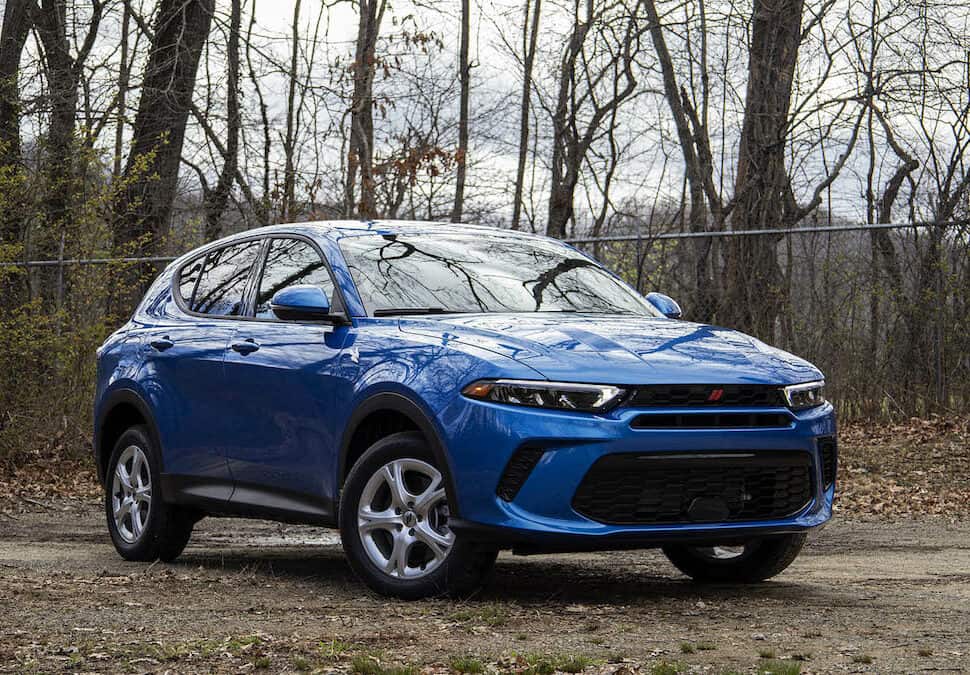
- Distinctive muscle-car styling
- Sharp, agile handling (GT especially)
- Strong plug-in hybrid system (R/T)
Cons:
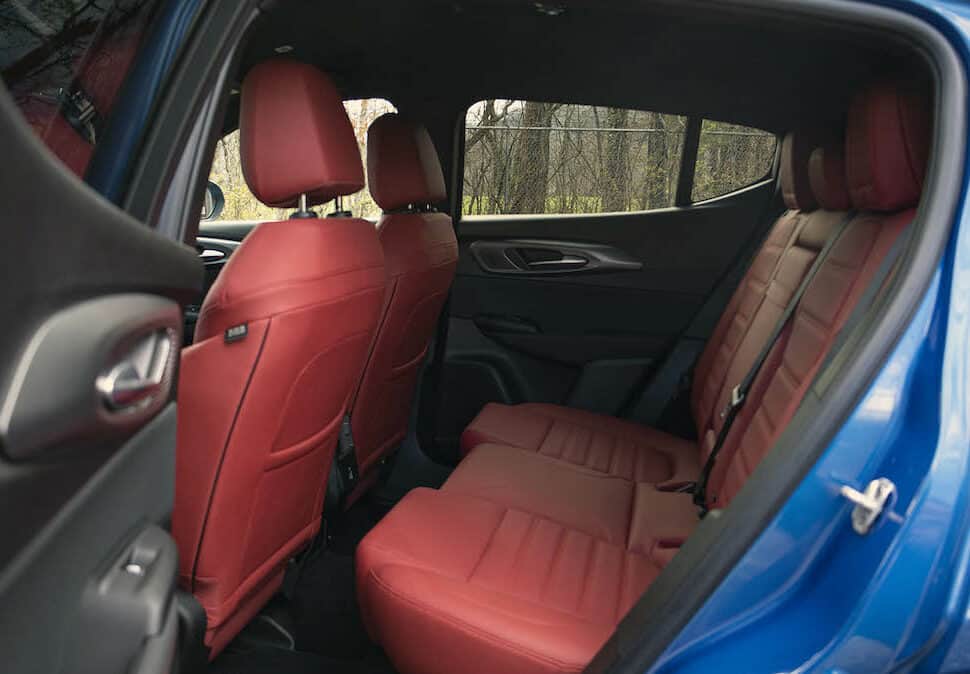
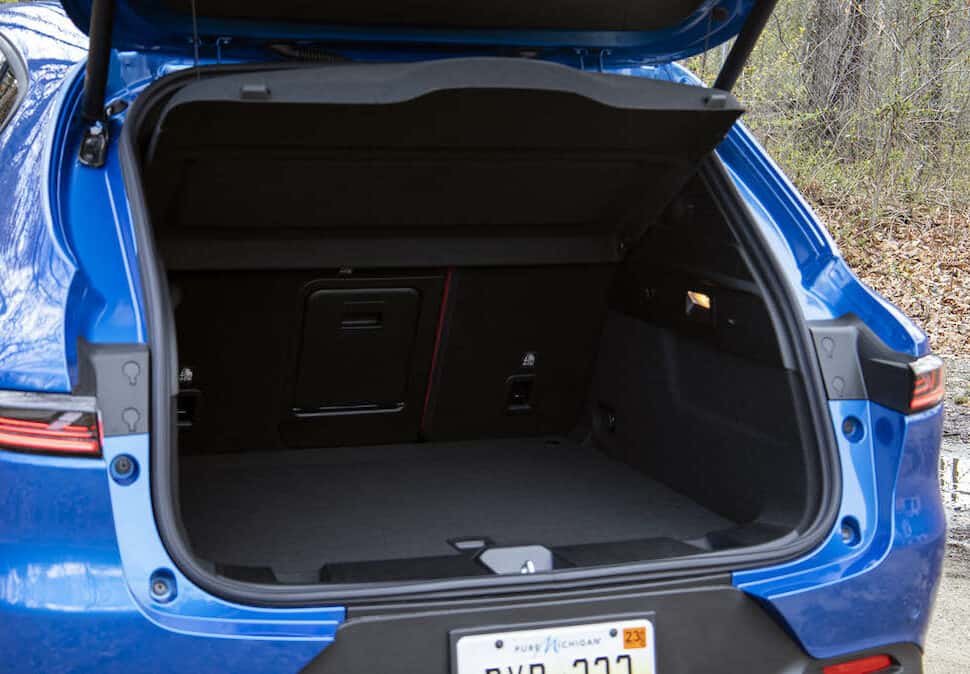
- Tight interior and cargo space
- R/T feels heavy and clumsy
- Expensive for its size
Except for the midsize Journey, Dodge never really had a compact crossover in its lineup. Its most recent stab at the segment came in the form of the Dart back in 2013, a compact car that didn’t exactly allow Dodge to gain much ground in that category. The Dart was such a commercial failure that it was taken off the market only three years after its launch, forcing Dodge to literally abandon the segment.
But none of this seems to bother Stellantis as it’s back for more, trying this time to convince consumers to sign up for a Dodge instead of an import. Except this time, it’s going at it through the lens of a small SUV. It’s called the Hornet, and we drove it during its North American launch in Asheville, North Carolina, to see if it’s worth your hard-earned money.
Related – 2023 SUVs Worth Waiting For: Redesigned & New Models Only
2023 Dodge Hornet Trims and Original Pricing
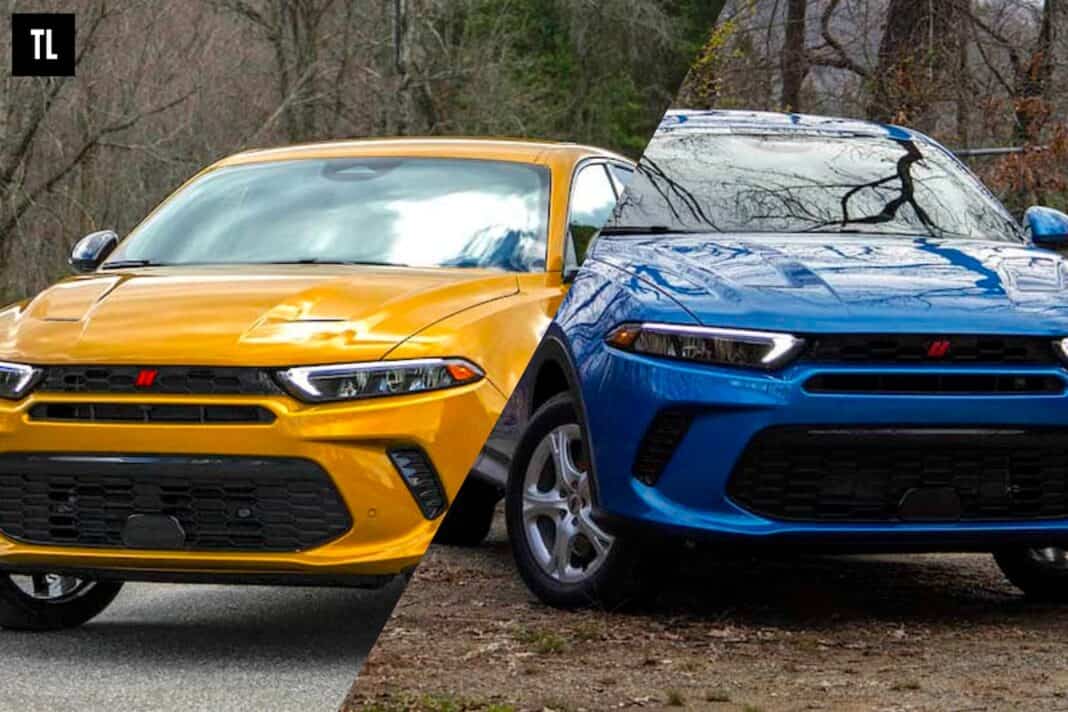
Although Dodge classified the Hornet as a compact crossover, its footprint is closer to today’s subcompact SUVs. That makes rivals like the Toyota Corolla Cross, Volkswagen Taos, Hyundai Kona, and Mazda CX-30 more natural competitors than larger compact models. Buyers could choose between two personalities. The turbocharged GT targeted buyers wanting a sporty gas-powered crossover, while the plug-in hybrid R/T added more power, electric driving capability, and incentive eligibility at a significantly higher price.
| United States | MSRP |
|---|---|
| GT | $31,590 |
| GT Plus | $36,490 |
| R/T PHEV | $41,590 |
| R/T Plus PHEV | $46,590 |
| Canada | MSRP |
|---|---|
| GT | $37,995 |
| GT Plus | $43,995 |
| R/T PHEV | $50,495 |
| R/T Plus PHEV | $55,995 |
Interior: A Small Cabin With European Flair
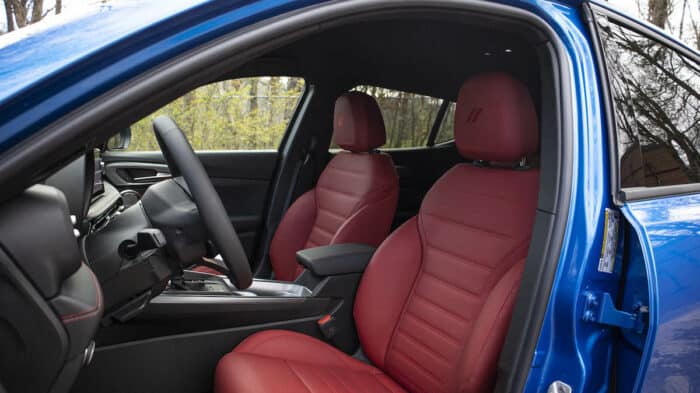
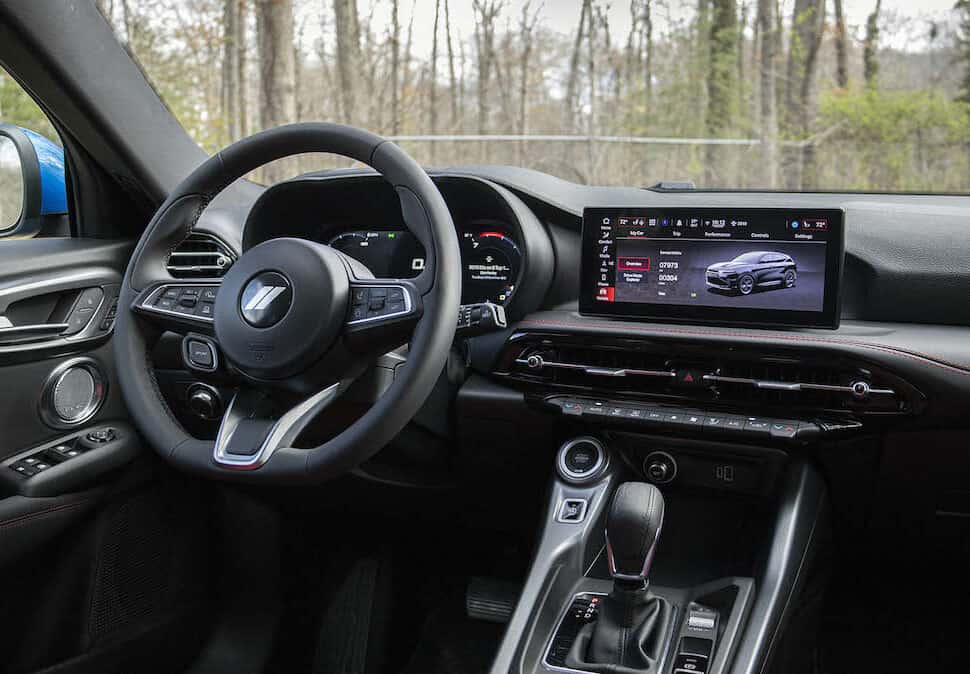
We say the Hornet belongs in the subcompact crossover space due to its small cabin dimensions. Inside, the Hornet reminds us of a first-generation Hyundai Kona in the sense that it’s narrow and not all that spacious if you’re tall. Door openings are not very wide and getting inside the vehicle requires lowering your head due to an aggressively raked A pillar.
“While it did feel considerably quicker than the GT, the Hornet R/T never really felt sporty from behind the wheel. Instead, there was a lot of buzz coming from the tiny 1.3L engine.”
The Hornet’s lilliputian dimensions are replicated out the rear where leg clearance remains short. We did, however, find the roofline high enough for taller people. However, total cargo space, with all seatbacks folded flat, not only trails behind all compact SUVs currently on sale (1,550L), but the tiny Hornet is even less practical than some subcompact models like the Corolla Cross (1,891L) or the Volkswagen Taos (1,705L).
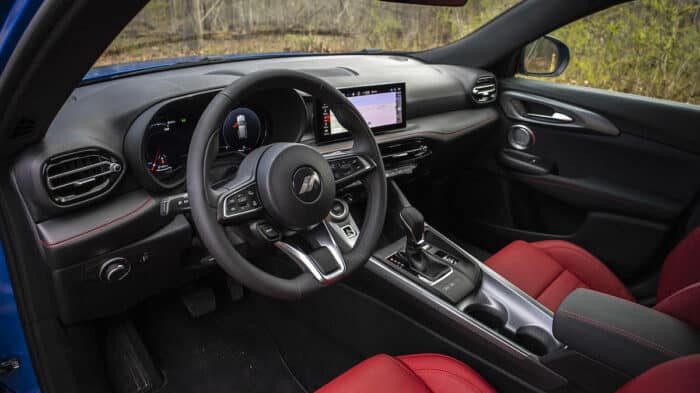
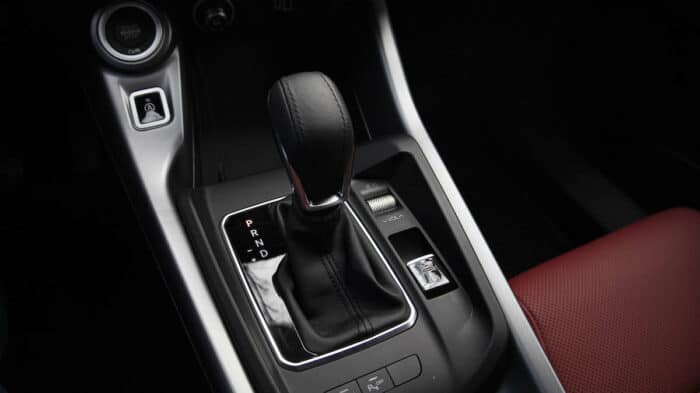
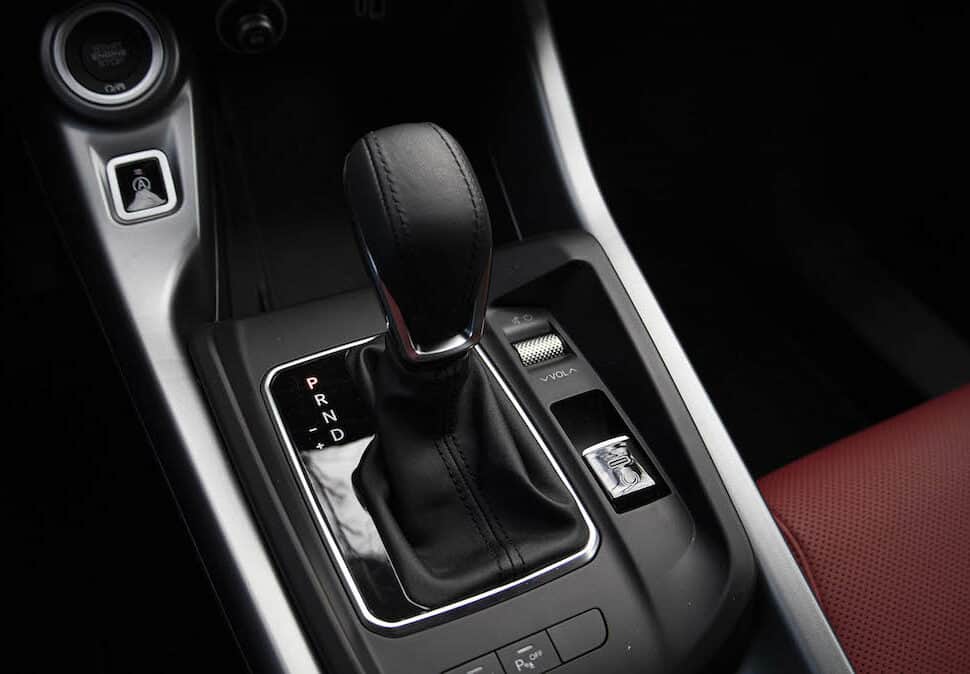
Dodge at least presents the Hornet’s cabin in a classy, European-inspired design theme, with high-quality materials and rather impressive build quality. The entire gauge cluster is both digital and fully customizable, while Stellantis’ Uconnect5 infotainment interface has already cleared most of the first iteration’s early glitches. The system looks good, is quick to react and incorporates a wide selection of neat menus that allow the driver to monitor the Hornet’s performance, fuel economy and EV range.
Two Powertrains, Two Very Different Hornets
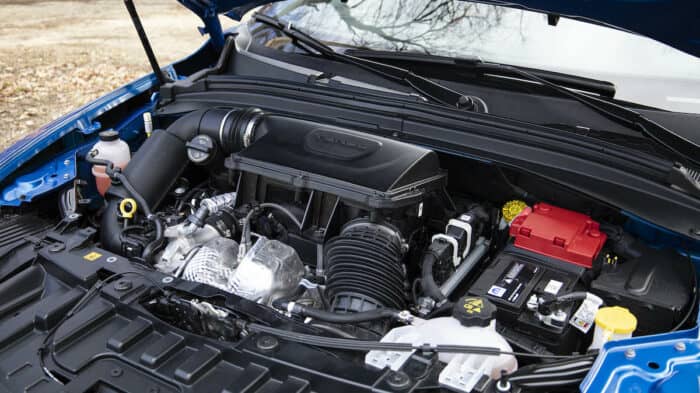
Dodge wanted the Hornet to reflect the performance legacy it has shoehorned over time with V8 muscle cars like the Charger and Challenger Hellcat. That’s why it equipped its baby crossover with a lot of muscle out of the box.
The GT Feels Lighter and More Playful
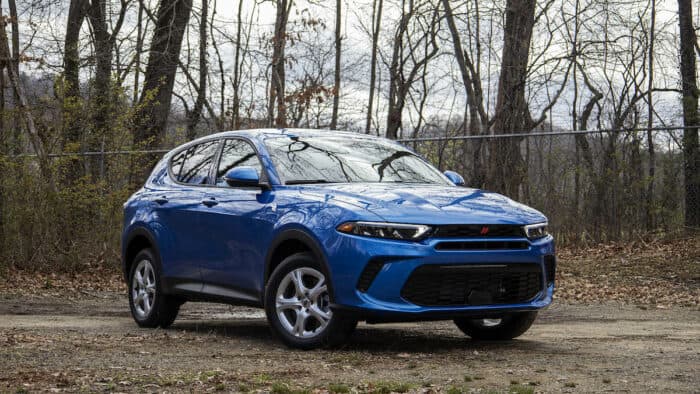
- Engine: 2.0L turbocharged four-cylinder
- Output: 268 hp / 295 lb-ft
- Transmission: 9-speed automatic
- Drivetrain: AWD
- 0–100 km/h: 6.5 seconds
- Towing: 2,000 lb
For instance, the Hornet GT gets the same turbocharged 2.0L four-cylinder engine as in the Alfa Romeo Giulia. It’s good here for a stout 268 horsepower and 295 lb-ft of torque. It’s mated to a nine-speed automatic transmission. All-wheel drive comes standard throughout the lineup. Dodge claims a 6.5-second 0-100 km/h acceleration time.
But while the true performance model is the R/T, we preferred to flog the GT around winding North Carolina roads. The Hornet GT feels light on its feet, agile, but also stiff like a small European car. The 2.0T engine was always up for the task, delivering ample power and torque throughout the rev range, while emitting some satisfying (pumped-in) sounds during the process. However, we did sense some lag in the transmission’s behavior and, at times, jagged performance.
The R/T Is Quicker, but Less Engaging

- Powertrain: 1.3L turbo PHEV
- Combined Output: 288 hp / 383 lb-ft
- Transmission: 6-speed automatic
- Drivetrain: eAWD
- 0–100 km/h: 5.5 seconds
- EV Range: 50 km (31 miles)
- Battery: 15.5 kWh
- Towing: 2,000 lb
The Hornet R/T, on the other hand, comes solely with a plug-in hybrid drivetrain. At its core lies a turbocharged 1.3L four-cylinder engine mated to a six-speed automatic transmission. It’s then attached to a belt-driven electric starter motor that acts as a generator to power accessories and assist the engine in lowering its emissions and fuel consumption.
A 15.5 kWh lithium-ion battery then takes care of propelling a second electric motor installed on the Hornet’s rear axle. This gives it all-wheel drive without the need of an actual driveshaft. When everything is operating in sync, the Hornet R/T pumps out 288 combined horsepower and 383 lb-ft of torque, dropping the 0-100 km time down to 5.5 seconds.

A PowerShot feature gives the Hornet a 30 horsepower boost for 20 seconds when the battery is at least 60% charged. Dodge says the R/T’s electric range is rated at 50 km, while level 2 charging operates at a rate of 7.7 kW.
While it did feel considerably quicker than the GT, the Hornet R/T never really felt sporty from behind the wheel. Instead, there was a lot of buzz coming from the tiny 1.3L engine. Transitions between electric and gasoline propulsion were also rough around the edges. The Hornet R/T felt heavy and clumsy on winding roads.
We were, however, impressed by its 4.8 L/100 km fuel consumption average when we ran the car in hybrid mode, and we experienced no problems trying to cover the advertised 50 km in fully electric mode.
Takeaway










Pros
- Distinctive muscle-car styling
- Sharp, agile handling (GT especially)
- Strong plug-in hybrid system (R/T)
Cons
- Tight interior and cargo space
- R/T feels heavy and clumsy
- Expensive for its size
The Hornet’s steep pricing and questionable positioning in the market have us scratching our heads. This puts Dodge’s little rascal in a difficult position. We say the Hornet GT is worth it when considered as a subcompact crossover, as it’s quicker and more fun to drive than most models in this class.
But while we do find the R/T’s plug-in hybrid drivetrain to be a compelling argument, the Hornet is sadly way too small to be truly taken seriously as a compact SUV. In this price bracket, we’d recommend considering larger models, things like the Toyota RAV4 Prime or the Kia Sportage PHEV.