

Editor’s Note: This guide has been updated for 2026 to reflect current research tools and reliability considerations.
Buying a used car can save you thousands…or cost you thousands. The difference usually comes down to research. A little digging before you commit can uncover patterns, known weak points, and repair costs that don’t always show up in a quick test drive. The information is out there if you know where to look. Here are three often-overlooked steps that can help you make a smarter pre-owned purchase.
Start With Owner Forums (But Read Between the Lines)

You may not consider yourself a car enthusiast, but it’s worth paying attention to some of that car-related chatter. The Web is rich with discussion forums dedicated to just about every make and model of car or truck, and among that talk are clues you can use to make a smart used vehicle purchase decision.
Among all the discussions about aftermarket wheels and lowered suspensions, you’ll find conversations about what’s gone wrong with people’s vehicles.
Knowledge is power: the key is not necessarily to avoid a car you discover has a less-than-perfect reliability record; after all, no car will be flawless.
On the surface, many of these exchanges will look like little more than griping, but you can bet that if one person has had a specific problem with their car, other owners of the same make and model will have experienced it, too.
Throw in a few passionate vehicle owners, and the discussion will eventually come around to what causes the problem and how to fix it, even if the car in question isn’t a typical target of car lovers. Know how to look for these discussions, and you’re well on your way to learning what often goes wrong with any given vehicle.
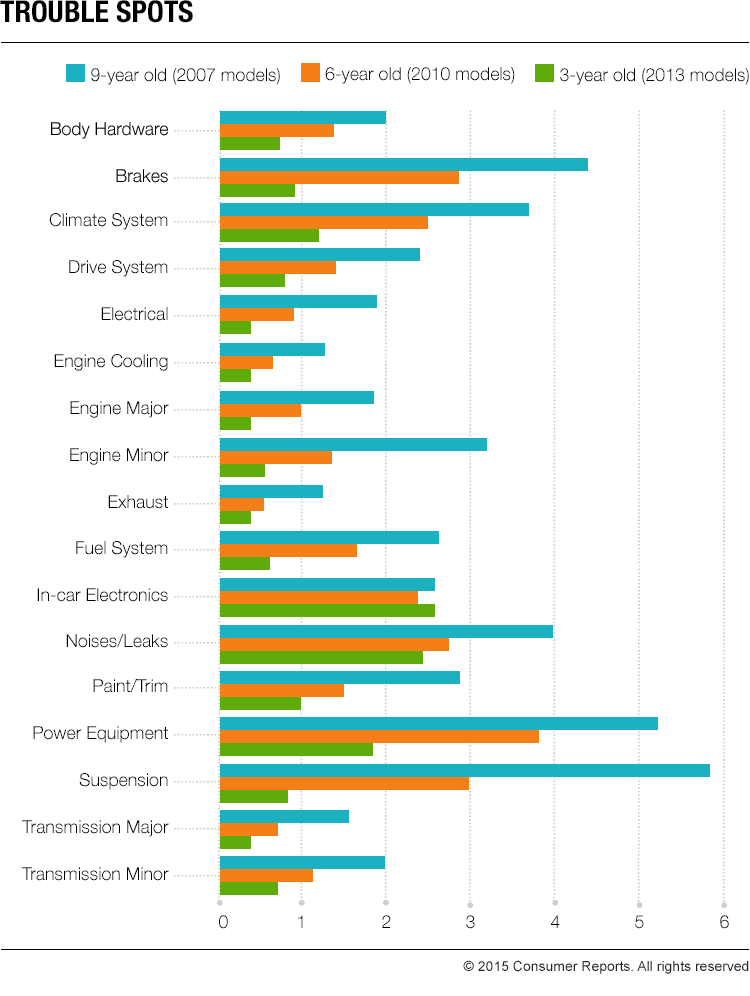
According to this Consumers Reports reliability survey, even the best cars develop problems as they rack up the miles. Here’s an interesting look at particular things that go wrong over time:
Identify Known Mechanical Weak Points Before You Test Drive
But what if you have your heart set on a particular model, only to discover that several potentially expensive problems could crop up on a car with no remaining warranty coverage?
Example 1
For example, a particular model might have a history of transmission hesitation, premature turbocharger wear, or timing chain issues that only surface after higher mileage. Direct-injection engines may require periodic carbon cleaning, and some continuously variable transmissions (CVTs) are known to develop shuddering or delayed engagement as they age.
Not every issue will be expensive, and not every vehicle will experience the same problems. The point isn’t to eliminate a car from consideration at the first sign of a known fault. It’s to understand what commonly goes wrong, how serious the issue tends to be, and what a proper repair typically costs.
When you go into a purchase knowing a vehicle’s mechanical reputation, you’re far less likely to be surprised after the paperwork is signed.
Example 2
Any repair involving an engine’s timing chain promises to be labour-intensive and expensive.
In GM’s 3.6L V6, a stretched timing chain is caused by too-long oil-change intervals recommended by the car’s oil life monitor, and in Nissan’s 4.0L (VQ40) V6 engine, a pair of timing chain guides can wear out, causing a whining noise and potential driveability problems.
Check Technical Service Bulletins (TSBs) Before You Buy
Technical Service Bulletins (TSB)
Many of the issues listed above have been addressed through technical service bulletins (TSB), documents issued by manufacturers to help their dealer service technicians diagnose and repair common faults in a vehicle. These are distinct from recalls in that they don’t entitle you to a free repair; instead, they’re designed to save the technician (and, hopefully, you) time that would otherwise be spent on a lengthy diagnosis.
Once a manufacturer recognizes that a significant number of vehicles are coming into dealer service bays with the same problem(s), it will have its engineers come up with a process to help technicians identify the fault and then lay out a repair procedure, which may include redesigned parts.
Many of these repairs are only covered while the vehicle is under warranty, so it’s important to confirm whether any applicable updates have already been completed. (Unfortunately, this indicates that many vehicles are reaching the marketplace without undergoing sufficient durability testing, but that’s a story for another day.)
Bulletin Resources
NHTSA’s bulletins: These service bulletins are available to everyone but usually not for free. The National Highway Traffic Safety Administration (NHTSA) maintains a searchable TSB database but only provides summaries of the bulletins.
In addition to service bulletins, a quick VIN check through the manufacturer’s website can reveal open recalls, and vehicle history reports can provide insight into past accident damage or major repairs.
ALLDATA DIY and Other Repair Databases: Professional repair databases such as ALLDATA DIY provide access to service bulletins, wiring diagrams, and factory repair procedures for specific vehicles. These services require a paid subscription, but they can be useful if you want deeper insight into known issues before purchasing. For most buyers, however, the free NHTSA database and targeted online searches will surface the most common bulletins without requiring a subscription.
Various private discussion forums: That said, you will see bulletins in these forums, but usually only if someone posts them in a discussion about an issue with a particular vehicle. Your best bet on a budget? Use the NHTSA’s database to look up TSBs for the vehicle you’ve got on your mind, and then search the web for the document number (all TSBs are numbered). If you’re lucky, that TSB will have been discussed and posted in a forum where you can see the details.
Takeaway: Online Car Research is a Powerful Tool
The tools available to used car buyers today are better than ever, but they only help if you take the time to use them. A few hours of careful research can reveal patterns, common failures, and maintenance expectations that aren’t obvious at first glance. Buying used doesn’t require mechanical expertise; it requires preparation. The more you understand before you buy, the more confident you’ll feel once you’re behind the wheel.
Always Cross-Check Reliability Data
Forum chatter can be useful, but it’s not the whole picture. A few vocal owners can make a minor issue seem widespread, while a genuinely common problem might barely register in online discussions.
That’s why it helps to cross-reference what you’re reading with broader reliability data. Owner surveys from sources like Consumer Reports can highlight recurring trouble spots — engines that burn oil, transmissions that hesitate, electronics that don’t age well.
No vehicle is perfect. The goal isn’t to find a flawless car, but to understand what typically goes wrong and what it costs to fix. With that context, you’re negotiating from a position of knowledge rather than guesswork.
What to Ask the Seller Before Buying a Used Car
Once you’ve narrowed down your choice, ask direct questions. Start with maintenance history. Has the vehicle been serviced on schedule, and are there records to prove it? Consistent maintenance often matters more than mileage.
If your research revealed common issues for that model, ask whether those repairs have already been completed. Documented timing chain replacement or a fuel pump update can save you from an expensive surprise.
Finally, check for outstanding recalls and confirm there are no unresolved issues tied to the VIN. Buying used doesn’t require deep mechanical expertise — just preparation and the willingness to ask the right questions.