
I must admit that when the last generation of the Volkswagen Beetle hit the streets, I wasn’t very impressed. Marketed as the New Beetle, this retro-flavoured punch buggy was far too cute to appeal to a manly individual like myself.
All kidding aside, the car initially proved to be a strong seller, as buyers typically embrace products that are all-new or represent the trendy flavour-of-the-day, but it also benefited from its ability to kindle fond memories of times past.
Now referred to simply as the Beetle, or, in my tester’s case, informally as the Turbo, the 2013 edition of this curvaceous runabout has sparked renewed interest in the storied model. But, of course, today the Beetle is no longer in production across North America, discontinued for several reasons.
Related – 2016 Volkswagen Beetle Dune Review
Beetle Turbo’s More Aggressive Styling

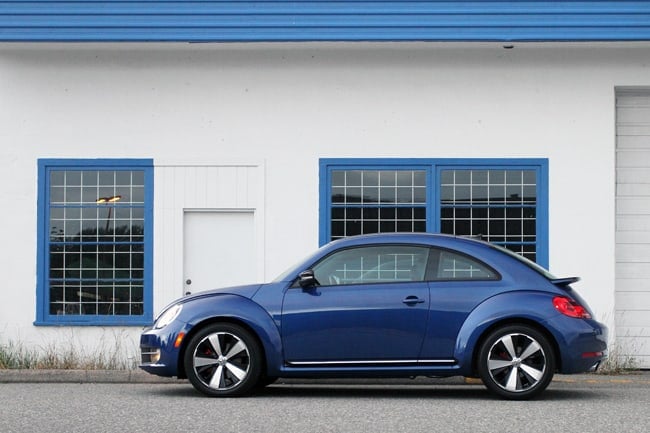
For those familiar with the styling of the previous iteration of this car, the look of the latest edition will seem familiar, as it still maintains the basic elements that combine to pay homage to the original Beetle, the car that started it all for Volkswagen almost 75 years ago. The half-moon shape of the passenger cell remains, although the curvature of the roofline has been reduced, resulting in a shorter window height that almost gives the car a chopped, custom look.
“What this latest example offers that its forbearers did not is a driving experience that rivals that of its GTI sibling. And for this, Volkswagen should be proud.”
The front fenders look less pronounced, and the hood appears to be a little longer, with its curves less pronounced. I guess this proves that while men do love curves, they don’t find them overly appealing on compact automobiles.

This was a major problem for the New Beetle, as it garnered the bulk of its attention from female buyers, so the directive given to the designers of the new car was to add a hint of machismo in an effort to attract male buyers and enlarge the potential customer base.
The revamped Beetle debuted in late 2012 with a much more gender neutral design. The car has grown in virtually every dimension, but it hides it well, so it doesn’t look ungainly. The new model is both longer and wider than the outgoing car, but it also sits almost half an inch lower.
18-inch Beetle wheels, deck spoiler, twin exhaust pipes
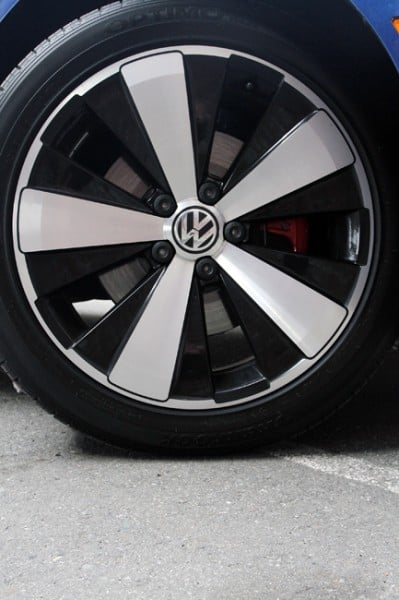
A host of additional styling modifications help give the Beetle Turbo a look that’s aggressive enough to capture the eye of driving enthusiasts without crossing into boy-racer design. The car seems to be ready to pounce as it sits perched on the bold, 18-inch, five-spoke, two-tone wheels. A subtle deck spoiler and twin exhaust pipes highlight the car’s aerodynamically sculpted rear end, which is much more mature-looking than that featured in the previous Beetle design.

The Beetle Turbo comes decked out with the Sportline trim package, which includes such niceties as the aforementioned 18-inch alloy wheels and brake callipers painted in bold red. Other exterior embellishments include a distinctive front grille with fog lights and black-coloured side mirrors, window trim, and running boards.
For something a bit more distinct, the Beetle’s Fresh Fuchsia Metallic paint was new for 2017, and paired with a set of 18-inch gunmetal wheels that look fab next to that gorgeous paint, and the package is topped off with an adorable “Bug” badge on the trunk lid.
Related – 2017 VW Beetle Pink Edition Review: Weird Yet Charming
2013 VW Beetle Turbo Interior

As a larger individual, I often find small cars to be unpleasant to drive due to their cramped cockpits and limited interior real estate. This is not the case here. I found the passenger cabin to be very comfortable, especially in the driver’s position, as there is abundant leg, hip, shoulder and head room.
Much has been improved with regard to the car’s interior appointments, and the rear seat passengers will appreciate a little more headroom with the new design. I found the driver’s seat to be supportive enough for my larger frame, and I had plenty of space in the foot well for my size 14 feet. The rear compartment has benefited from the car’s growth spurt, especially in the legroom department, but in reality, this space is best reserved for children and diminutive adults.
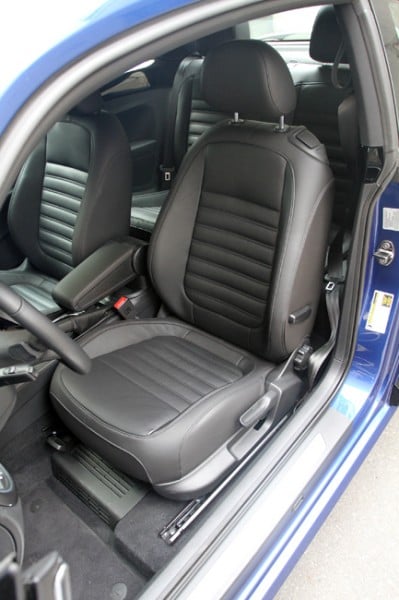
The dash layout is simple and uncluttered, and switchgear has been kept to a minimum. The compact instrument cluster features just the necessities and is surrounded by bright alloy trim and imitation carbon fibre to add a sport-minded flair. Gone is the novelty bud vase, and in its place we get functional gear like the leather-wrapped, flat-bottom steering wheel, light alloy pedals, and a turbo boost gauge.
Other options on my test unit included the Connectivity Package, which includes the media device interface with iPod connectivity and Bluetooth phone capabilities. This package is a supplement to the Technology Package, which includes a multifunction touch-screen which serves as the command module for both the navigation and premium Fender audio system.
More Than Just Straight-Line Speed

- Engine: 2.0L turbocharged inline-4
- Output: 200 hp / 207 lb-ft
- 0–100 km/h (0–62 mph): ~6.0 seconds
- Transmission: 6-speed DSG automatic
- Drivetrain: Front-wheel drive (XDS electronic limited-slip differential)
- Wheels/Tires: 18-inch alloys with performance tires
Strong Turbo Power, Minimal Lag
Under the Turbo’s clamshell hood resides a 2.0L, direct-injected and turbocharged four-cylinder engine that produces a healthy 200 horsepower and 207 lb-ft of torque. This is enough power to give the car the ability to sprint from 0-100 km/h in a very respectable six seconds.
The 2013 VW Beetle Turbo seemed to enjoy being tossed through the curves of the winding, rural back roads that comprise the bulk of one of my favourite test loops. The car accelerates with authority as the transmission clicks from gear to gear at the mere touch of the steering wheel-mounted paddles.

Power delivery flows strongly and consistently as my heavy foot presses down on the gas pedal in my quest for triple-digit speeds. There is little, if any, evidence of turbo lag from this potent little power plant, which has been designed to deliver its optimum levels of power at a very low 1700 rpm. That being said, I found the engine was ready to pull all the way to its redline.
Composed Handling With Real Grip
The wide track and stretched wheelbase help the Beetle Turbo provide a much more satisfying driving experience. During my week with the car, I managed to spend some quality time tearing up some of my favourite country back roads to see if the Turbo had any significant handling faults.
What I discovered is that the car exhibits crisp handling and the steering provides excellent feedback. Steering is responsive, and my inputs placed the car exactly where I wanted it to go. The chassis is well developed, and the suspension handled road irregularities very well.
Under hard acceleration, the six-speed, DSG, Tiptronic transmission is a star as I was able to flick up and down the silky gearbox at a rapid pace and in a seamless fashion.
The rear of the car stays planted to the tarmac due to the relatively low centre of gravity, but the presence of a fully independent rear suspension helps as well. The delivery of power to the ground is also more efficient as the vehicle is equipped with Volkswagen’s slick XDS electronic limited-slip differential.
The car’s big 18–inch alloy wheels are wrapped in meaty performance tires so the package has a substantial contact patch and tremendous grip. Having the rolling apparatus at each corner gives the car a very tossable feel, but exhibits very little body roll.
Confidence-Inspiring Braking Performance
Under extreme braking conditions –a series of controlled panic stops from 100 km/h- the car’s oversized brakes reined in the fun and brought me to a comfortable stop in short order and without any excess drama. After an afternoon of driving that featured a series of extended climbs and descents on a mountainous test loop, I found the brakes to perform flawlessly. Pedal feel remained positive, and the brakes seemed very resistant to fade.
Takeaway: Is the 2013 VW Beetle Turbo worth buying?


Pros
- More aggressive styling should broaden appeal and generate sales
- Larger size improves overall ride quality and passenger comfort
- More satisfying driving experience
Cons
- Ingress and egress to and from the rear compartment can still be a challenge
- Tough competition resides in-house in the form of the GTI
- You may have to explain bruises as your friends/foes land punches to your shoulder whenever they spot you with your Beetle
The 2013 VW Beetle Turbo’s new look is bold yet familiar, capturing the essence of the basic shape of every Volkswagen Beetle that came before it. But what this latest example offers that its forbearers did not is a driving experience that rivals that of its GTI sibling. And for this, Volkswagen should be proud.