
A funny thing happened on the way to declaring the wagon “dead.” The format didn’t croak. It simply went upscale.
A poorly kept secret that exhibits this within the car industry is that Subaru Outback customers tend to repurchase their latest wagons in cash. You may not think of Subaru customers as wealthy, but full cash purchases for any car these days takes a fair bit of liquidity. (And, frankly, we wouldn’t call the newest Outback a wagon anymore.)
Meanwhile, BMW, Mercedes and Audi have quietly not zeroed out their own wagons (nor has Volvo), they’re just adjusting the tariff impact on these luxury models and further padding their bottom lines by continuing their sale in North America. (Should some political pique someday make the tariff load a bit too high, eventually, well-cottled Americans will perhaps pay a further duty to re-import Canadian-sold wagons southward.)
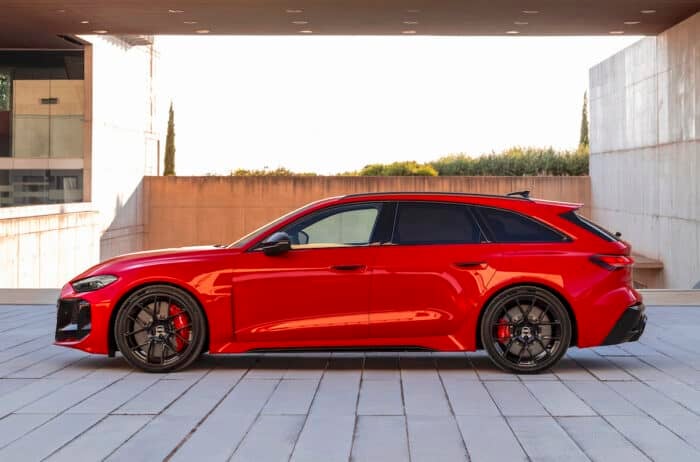
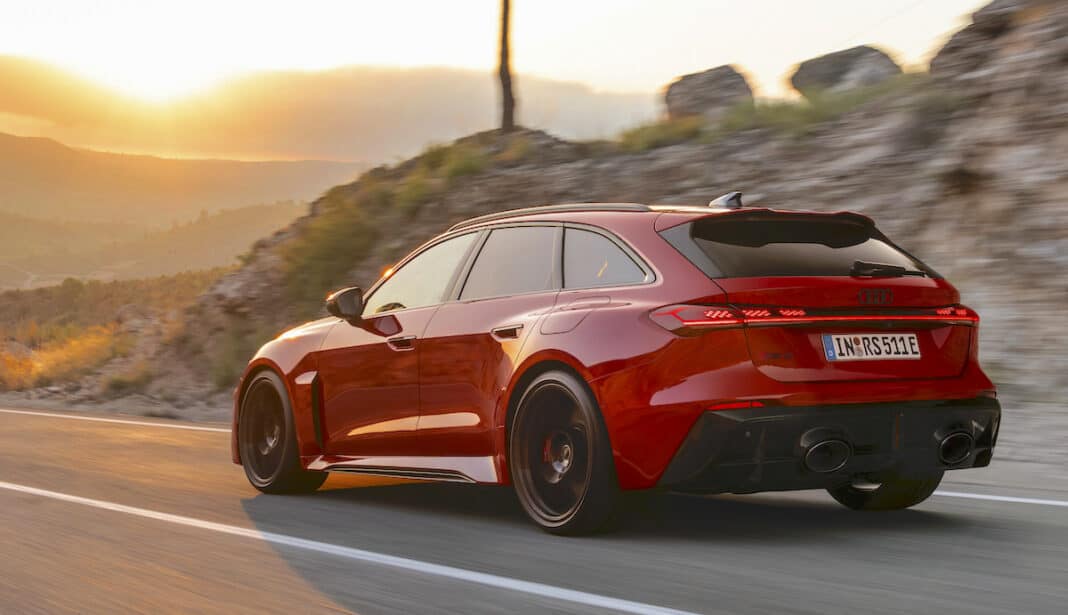
Speaking of upside-down logic (i.e., ignoring technological breakthroughs), it may defy a certain governmental kind of thinking that electric propulsion is in fact very advantageous, but luckily Audi isn’t run by bureaucrats. So the 2026 RS 5 wagon and sedan, whenever they go on sale (and Audi has confirmed they will sell in North America), deploy a combined twin turbo 2.9-liter V-6 good for 503 horsepower, plus an electric motor at the rear axle, adding another 127 horses.
This is the first PHEV high-performance Audi, too. And hybridization and electrification, sure as the tides, will come to every vehicle eventually. Want to know why? It’s all about speed and reacting to the road and the driver. And the RS 5 demonstrates all those whys, enumerated below.
Related – Why the 2025 RS6 Avant GT Might Be the Last Great Super Wagon
Quattro Like You’ve Never Known It
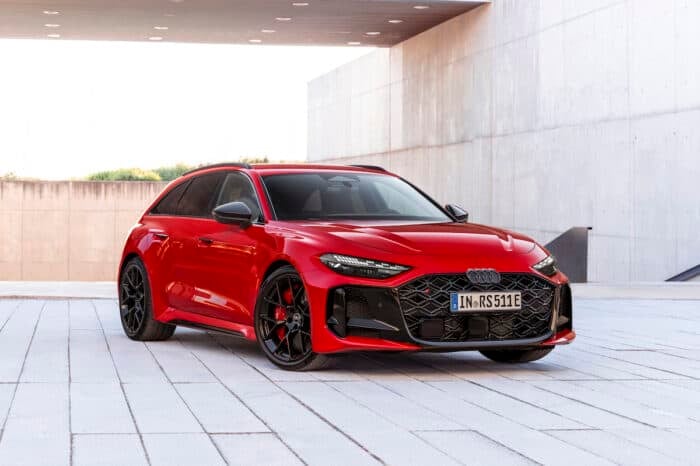
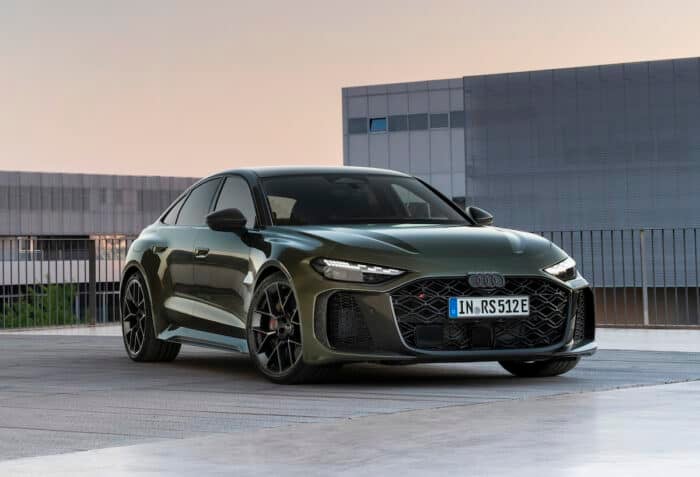
Audi rather famously crushed the rest of the rally world when they first brought their AWD tech to racing in the 1980s. Nearly half a century later, by hybridizing the RS5, Audi’s Dynamic Torque Control now becomes the world’s first electro-mechanical torque vectoring system on a production car.
This begins by having a center diff that’s always feeding a little bit of propulsion between the two axles (maximum split is 15 front/85 rear). This works off-throttle, too, enabling what Audi says is reduced understeer even under braking or hard cornering.
The RS 5 was never going to be cheap. But a roughly 14 percent drop in the U.S. dollar’s strength over the past year means that at current exchange rates, the RS 5 will start at $125,000 USD.
At the rear, left-right torque vectoring, likewise, functions even without throttle input or under braking, again allowing quicker rotation with less understeer. But Audi says that because this functions not just mechanically, but electronically, by monitoring the torque split constantly (as well as steering angle, slip, and many other factors), the system can feed torque into the rear wheel with the most traction, or conversely, over-drive the outside rear wheel in a corner, to increase rotation. Further, the system can also retard rotation, say during high-speed lane changes, to increase stability.
This is all very cool, because it means that Quattro now works not just to propel the car, but to twist it more quickly around corners. And my hope is that this kind of torque vectoring feels more natural, so this Audi won’t just be fast, but will feel mechanically visceral and alive.
Related – Jon Olsson’s 2014 Audi RS6 Wagon: The Ultimate Winter Wagon
A Unique Powertrain
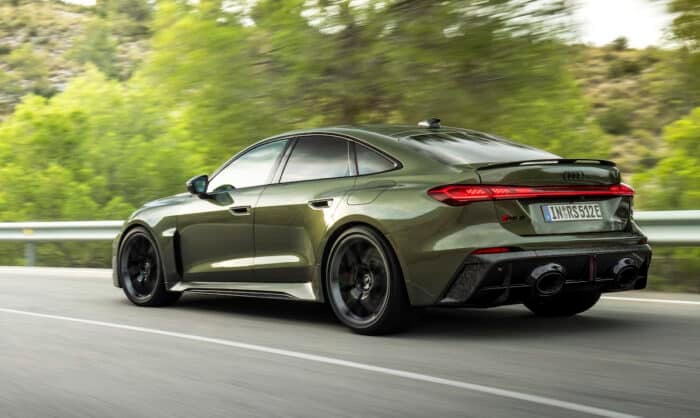
Audi’s first PHEV is pretty unique as a hybrid, too. First, with a relatively large (for a hybrid) 25.9 kWh battery, Audi says that on the European cycle, the RS has up to 54 miles of EV-only range. Even if that works out to 30 miles of real-world driving, that’s decent, and means that a lot of urban duties can be performed without burning gas. No, this buyer isn’t pinching pennies, but they may want the best of both worlds, with EV capability to reduce smog in a city like L.A., and the ability to canyon carve at will.
As for the latter, Audi says combined torque is a whopping 608 ft lb, and thanks to the electric side belting forth 339 ft lb from a standstill, Audi predicts a 0-100 KPH time of just 3.6 seconds. The V-6, for its part, gets water-cooled twin turbochargers, and uses a modified Miller cycle that reduces fueling losses and lowers emissions. Audi says these changes result in both quicker response and 20 percent higher efficiency under hard throttle.
By the way, thanks to electrification, Audi’s eliminated any need for a starter motor, since the electric motor can take over that duty.
Racing Suspension and Brakes
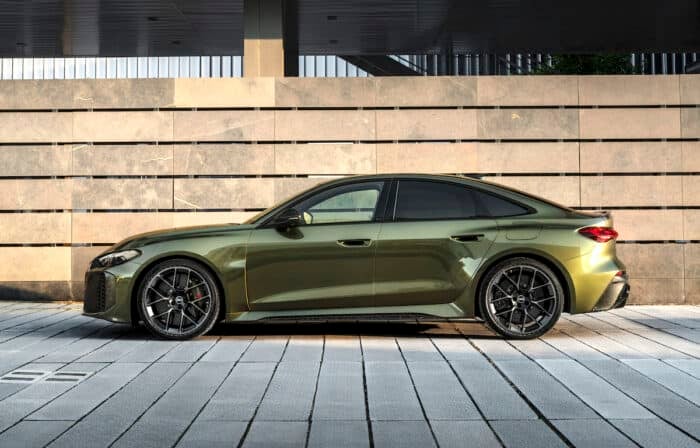
A lot of luxury carmakers prefer air suspensions to cushion cornering. But these are rather famous, over time, for becoming unreliable. Here, the RS gets Audi’s multiple modes for shift logic, power, exhaust, and suspension, and the latter’s twin-valve shock absorbers aren’t air, but hydraulic, and constantly calibrated for compression and rebound, and Audi says they allow a very broad range, from very compliant to race-track hard.
Likewise, and fitting for a car this capable, Audi’s shodding the RS sedan and wagon with stock 20-inch and 21-inch wheels and the option of ceramic brakes both front and rear. Go that route, and you’re looking at shedding 30 kilos/66 pounds per wheel. Also, these can stop the RS from 100 KPH in a mere 30.6 meters. I would love to know how many gs you’ll experience standing on these stoppers—but I might not want to experience brakes that powerful! Still, everyone knows that you don’t win races by going faster—you do it by stopping in a shorter distance. Or, if you’re not racing, you still avoid accidents by being able to stop on a proverbial pimple.
Americans Will Get the RS 5 — But Not All Its Tech
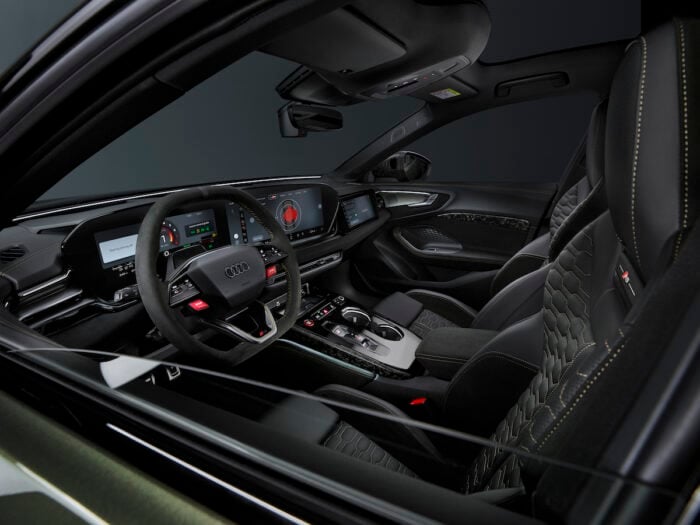
There’s some tech Americans will not get (Canadians, rejoice, because your government is smarter). Audi’s Digital Matrix headlights are more like LED TVs. Dumbed down, the way they work is by either masking a tiny mirror, to darken its display, or by illuminating it, projecting light. The system consists of 1.3 million of these micromirrors, and they adjust 5,000 times per second. Audi’s system reads the road ahead, as well as oncoming traffic, and continually adjusts every pixel in this display to only illuminate what the driver needs to see, while shading oncoming drivers. The result is like a mixture of a high beam on your side of the road, and only a shadow for the oncoming driver.
No, American regulators still haven’t ok’d this tech, even though they did green light a different version of something similar, and both Rivian and Tesla have managed to jump through the red-tape hurdles to sell vehicles with their own adaptive headlights.
A Deflating Dollar Makes the RS 5 Very Expensive
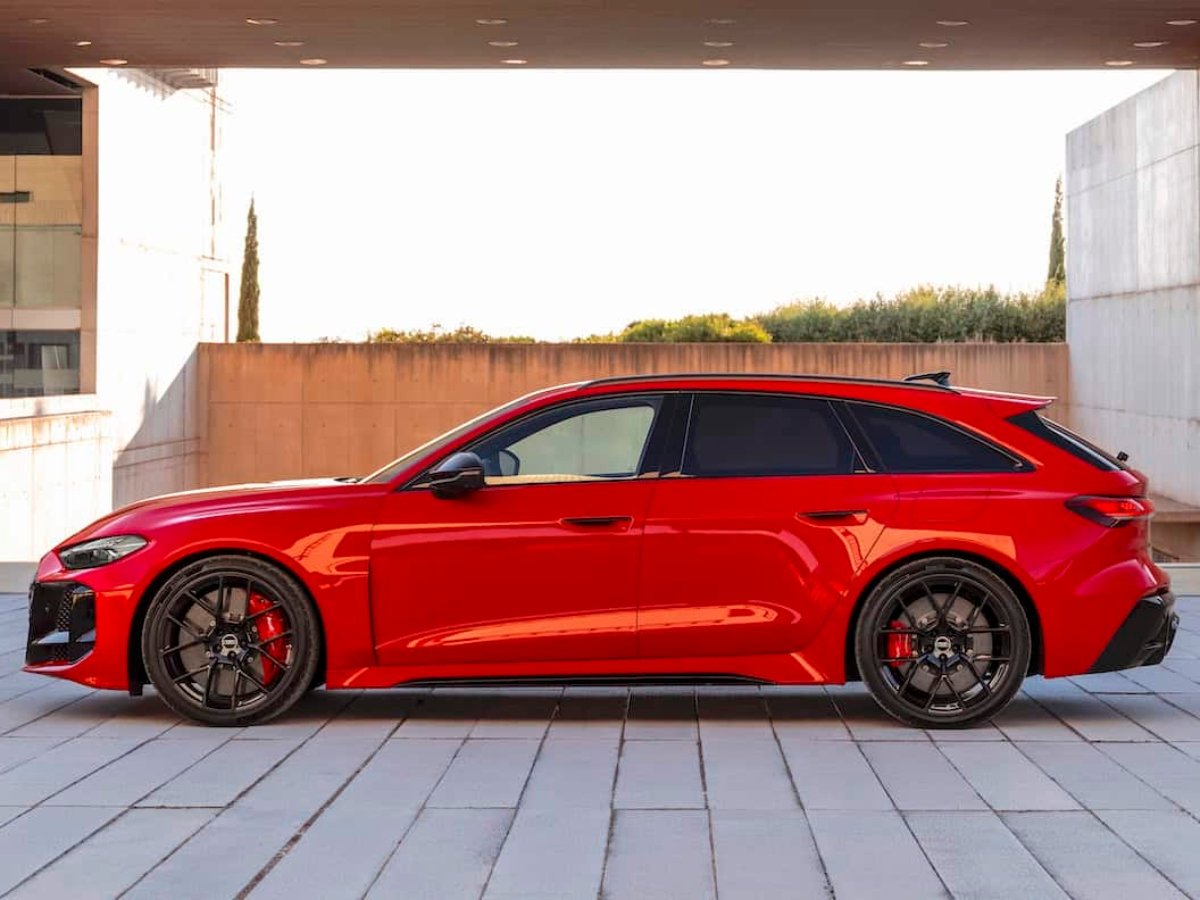


The RS 5 was never going to be cheap. But a roughly 14 percent drop in the U.S. dollar’s strength over the past year means that at current exchange rates, the RS 5 will start at $125,000 USD. That’s speculative, because Audi hasn’t announced U.S. or Canadian prices, and this car won’t be on sale in Germany until this summer, when the sticker is 106,200 euros. But I’ll say this for certain: It’s not going to be the most affordable PHEV you can buy this year. However, it sure might be the coolest one.