


Editor’s Note: This is Canada’s Kuro Edition — essentially a blacked-out, fully loaded CX-30 Turbo. In the U.S., you’ll find a similar setup under different trim names.
Pros:
- Good to drive
- Punchy turbo engine
- Classy cabin
Cons:
- More sport, less utility
- Mazda3-on-stilts styling
- Disappointing fuel economy
Do subtle updates and a turbocharged motor increase the appeal of this lifted hatchback? The past year has brought mixed fortunes for the Mazda CX-30, which recorded a 15% rise in Canadian sales but a 41% fall in the US. Now, the 2026 model year brings some mild mechanical upgrades and a new trim package for Mazda’s smallest North American crossover.
All grades receive new shock absorbers, aimed at better ride comfort, while new software enables the brakes to act as a limited-slip differential (LSD), with the goal of improved traction on slippery surfaces.
We first sampled the CX-30 in 2020. Six years on, the subcompact crossover market has become even more competitive, so we spent a week with the latest incarnation – a turbocharged CX-30 GT Kuro (badged Aire in the US market) – to take a fresh look at its strengths and weaknesses.
Related – Mazda SUV Models Up Close: Smallest to Biggest
Subtle Changes, Same Confident Shape

Most 2026 CX-30s are powered by a 186-hp, 2.5-litre, ‘Skyactiv-G’ four-cylinder – similar to what was under the hood of our 2020 test car, but now without cylinder deactivation, so it uses about 5% more fuel. Mazda told us that the decision was made to remove cylinder deactivation in all 2026 models that use the 2.5-litre Skyactiv-G, not just the CX-30, “to simplify overall manufacturing complexity within our line-up”.
However, the GT is additionally available with a 227-hp (on regular fuel) turbocharged unit, as tested here in our 2026 Kuro. The GT Kuro (Turbo) tops the CX-30 range in Canada, but in the US, the range is broader and differently structured – see below:
| United States (2026 CX-30 Trim Pricing) | Price |
|---|---|
| CX-30 2.5 S | US$25,975 |
| CX-30 2.5 S Select Sport | US$27,660 |
| CX-30 2.5 S Preferred | US$29,290 |
| CX-30 2.5 S Aire Edition | US$29,850 |
| CX-30 2.5 Carbon Edition | US$31,030 |
| CX-30 2.5 S Premium | US$33,240 |
| CX-30 2.5 Turbo Aire Edition | US$34,410 |
| CX-30 2.5 Turbo Premium Plus | US$37,900 |
| Canada (2026 CX-30 Trim Pricing) | Price |
|---|---|
| CX-30 GX | C$29,300 |
| CX-30 GS | C$32,200 |
| CX-30 GS Kuro | C$34,400 |
| CX-30 GT | C$38,200 |
| CX-30 GT Turbo | C$40,600 |
| CX-30 GT Kuro (Turbo) | C$41,350 |
The turbocharged Kuro is mechanically identical to a regular GT Turbo, but black roof rails, mirrors, badging, and 18-inch gloss alloy wheels help to explain the choice of the ‘Kuro’ name – ‘black’ in Japanese – for the Canadian market. Other Kuro (Aire) upgrades from the standard GT include unique interior trim and a Bose 12-speaker audio system.
Related – First Drive: 2021 Mazda CX-30 Turbo Review
A CX-30 Interior That Punches Above Its Class
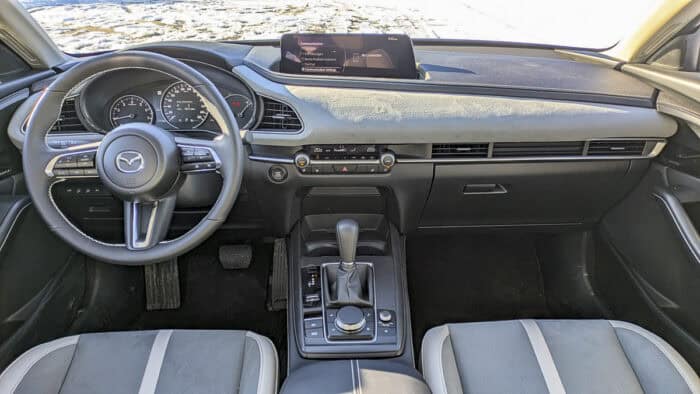
Inside, the Kuro/Aire gets exclusive white leatherette seats with grey ‘Leganu’ (faux suede) inserts and light-grey stitching. There’s more Leganu trim around the cabin for a noticeably airier, brighter feel than the typical blacks and greys.
As you’d expect from a Mazda, the cabin feels well screwed-together, too, with solid, premium-feeling materials for the dashboard, and satisfyingly tactile switchgear.
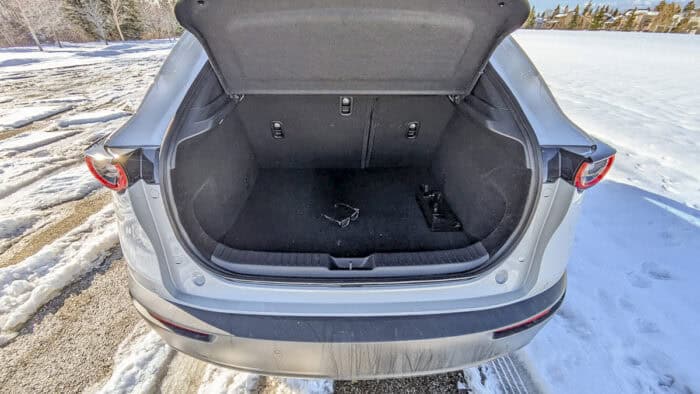
The packaging is further from the class best, however. Space in the front is a little tighter than you’d find elsewhere, and that lifted-hatchback silhouette – visually a little awkward, in our eyes – was always designed for style over interior volume.
Perhaps more pertinently, Mazda’s infotainment setup – touchscreen set high in the dash, rotary dial and scroll-heavy operation – is clunky by contemporary standards. In practice you’ll probably opt to connect your Android Auto or Apple CarPlay and use voice activation.
On the Road: Turbo Power, Done Right

- Engine: 2.5L turbocharged 4-cylinder
- Power: Up to 250 hp (93 octane) / 227 hp (regular)
- Torque: 320 lb-ft (93 octane) / 310 lb-ft (regular)
- Transmission: 6-speed automatic
- Drivetrain: i-Activ AWD (standard)
In 2025, Mazda sold almost twice the number of CX-30s in the US as it did Mazda3s, but sales of the two models were much more evenly matched in Canada
For the most part, the 2026 CX-30 drives like the 2020 edition, which is a good thing. Mazda can be relied on to deliver an excellent balance of ride and handling, and continues to inject more driver appeal into its crossovers than its mainstream competitors.
We didn’t notice a huge difference from the new shocks, and nor did we get into a position to put the new brake-based LSD to the test. But even on all-season tires, the CX-30 displayed good traction on the snow- and slush-covered roads of Alberta in April.
The turbo motor is torquey and refined, but the gearing makes it hard to sit at common speed limits without cruise control.
Whatever your speed, the Skyactiv-G turbo won’t win any fuel-economy prizes. In a vehicle of this size, an official combined consumption figure of 9.3L/100km (25mpg) feels higher than it should be in 2026; we recorded 7.7L/100km in mostly highway driving.
Takeaway

Pros
- Good to drive
- Punchy turbo engine
- Classy cabin
Cons
- More sport, less utility
- Mazda3-on-stilts styling
- Disappointing fuel economy
Buyers of subcompact crossovers are spoiled for choice. The Chevrolet Trax is great value. The Kias Seltos and Niro Hybrid are solid contenders. The recently updated Volkswagen Taos has a Euro vibe, while the Subaru Crosstrek is a perennial favourite with the outdoor crowd.
Some of these vehicles are roomier than the turbocharged CX-30 GT Kuro and others are more economical, but few will feel as solidly built or have as much appeal to keen drivers. The Mazda therefore remains attractive in this popular segment, but while gas prices are high, we’re sure that some buyers will consider more fuel-efficient options.