
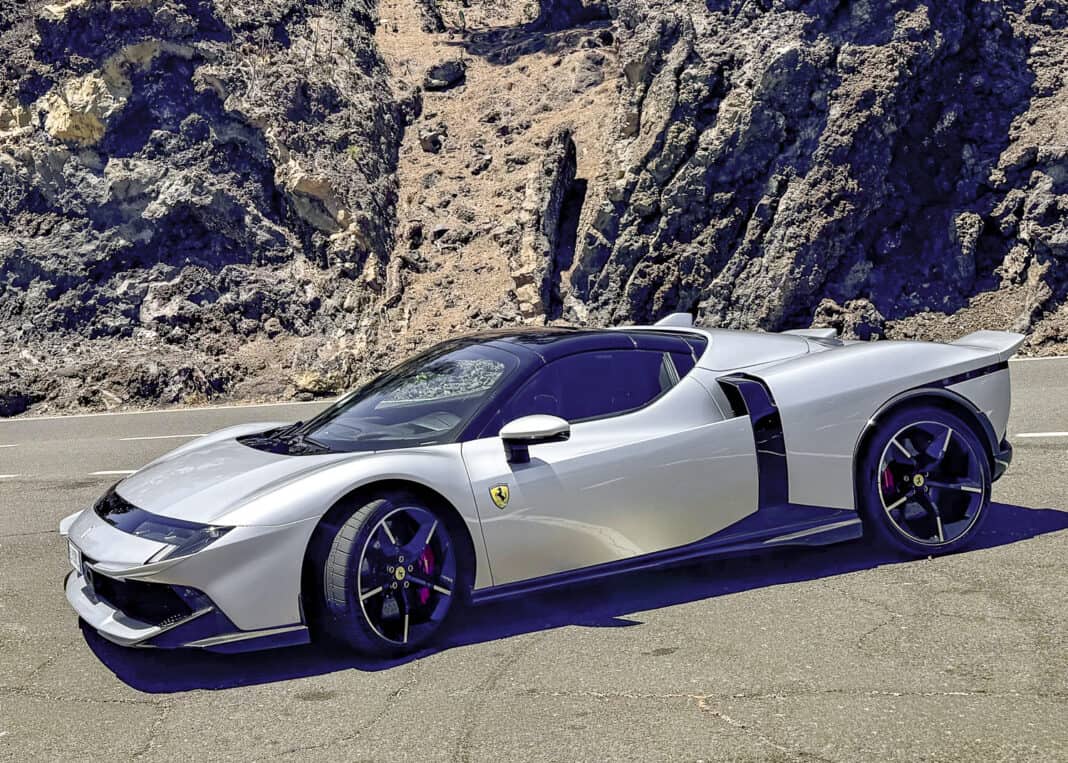
Tenerife, Spain — The danger of driving a 1,036-horsepower hybrid hypercar on public roads is not that the car will lose control. It’s that the driver might lose control.
The temptation is always there. An empty stretch of road appears. The steering wheel feels alive and weighty in your hands. The twin-turbocharged V8 is waiting behind the silence of electric propulsion. For a moment, the drive threatens to become a live-action version of Grand Theft Auto, only with real cliffs, the actual Atlantic Ocean, real traffic and consequences that cannot be erased by pressing “restart.”
That was the recurring tension during three-and-a-half hours alone with the new Ferrari 849 Testarossa Spider on Tenerife, the Spanish island off the coast of North Africa. The route began near the ocean, climbed toward El Teide, a volcanic mountain, and presented just enough open pavement to encourage bad decisions.
Ferrari has built a car that makes restraint difficult.
Power Without a Safety Net
- Powertrain: 4.0L twin-turbo V8 with three electric motors
- Output: 1,036 hp
- Drivetrain: On-demand all-wheel drive
- Transmission: 8-speed dual-clutch automatic
- 0–62 mph (0–100 km/h): Under 2.3 seconds
- Top speed: Over 205 mph / 330 km/h
- Electric range: Up to 15.5 miles / 25 km
The 849 Testarossa Spider combines a 4.0-litre twin-turbocharged V8 with three electric motors—two at the front and one at the back—for on-demand all-wheel drive and a total of 1,036 horsepower in North American terms. Ferrari says it can reach 100 km/h in less than 2.3 seconds, hit 200 km/h in 6.5 seconds and exceed 330 km/h.
There’s no reason to question these claims, none at all. Numbers such as these are entirely theoretical on public roads; what truly matters is how readily the performance arrives.
“In the 849, the road always felt close, but never dangerous.”
In eDrive mode, the Ferrari can travel up to 25 kilometres without starting the engine. It slipped through small towns almost silently, passing homes, cafés and pedestrians without announcing itself. Then, with the slightest movement of the accelerator pedal, the V8 joined in and the mood changed instantly.
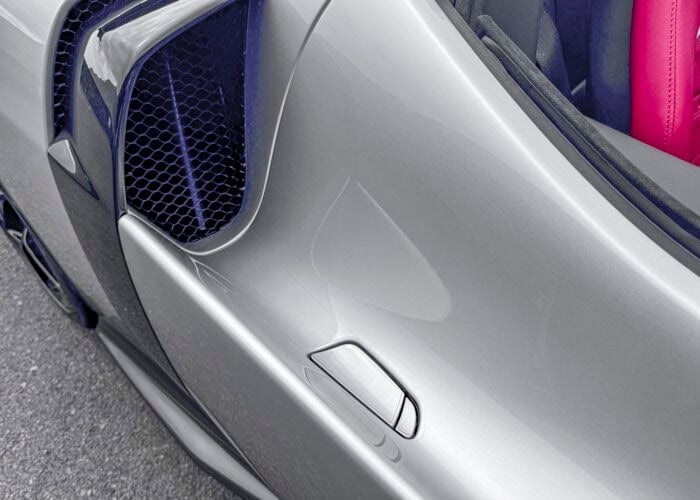
The transition from electric to hybrid power was remarkably smooth. There was no hesitation or obvious mechanical handoff. One moment the Spider was gliding; the next it was accelerating with the sort of force that compresses time and distance.
Outrage, Under Control
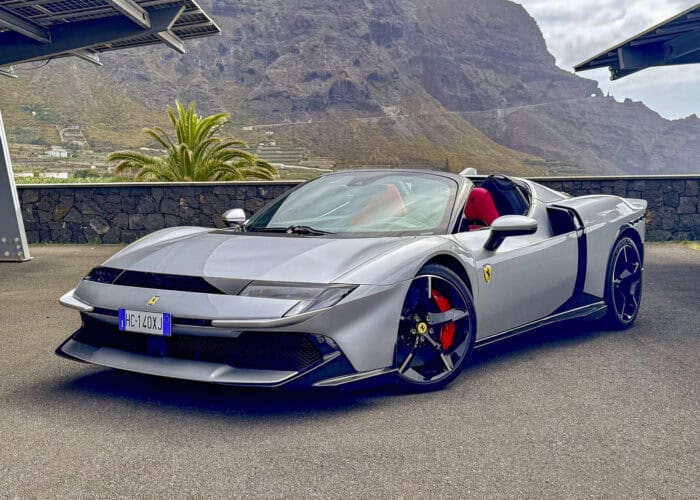
The performance was dramatic, but the car never felt unruly. The steering was precise, the brakes immensely powerful and the shifts from the eight-speed dual-clutch transmission occurred with almost unfathomable speed.
“It looks like something remembered from a more outrageous age, yet it drives with a level of control that belongs entirely to the present.”
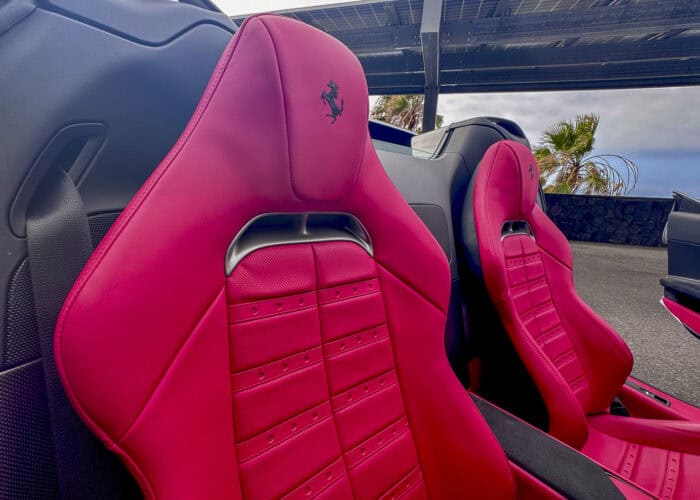
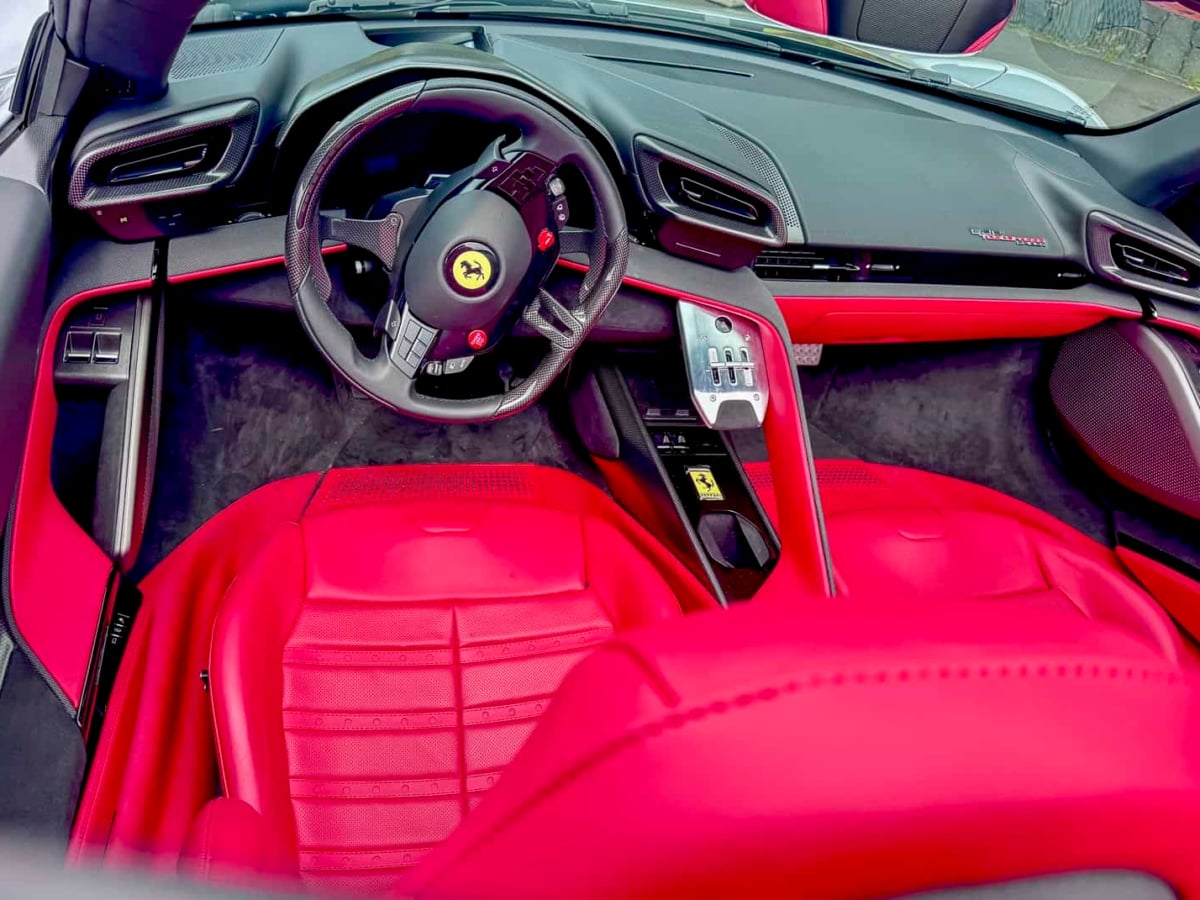
Despite its width, the Ferrari was easy to place. The low seating position, expansive windshield and mid-engine layout created the impression that the driver was sitting almost directly over the front axle. That confidence mattered. In an expensive supercar, one of the great anxieties is not knowing exactly where the nose ends or how close the front corner is to a wall, curb, drop-off or delivery vehicle. In the 849, the road always felt close, but never dangerous.
Related – 2023 Ferrari Purosangue SUV First Drive Review
The Past, Rewired
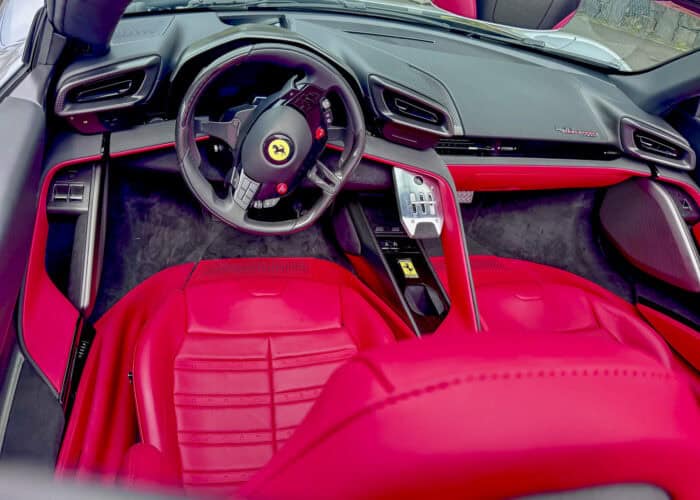
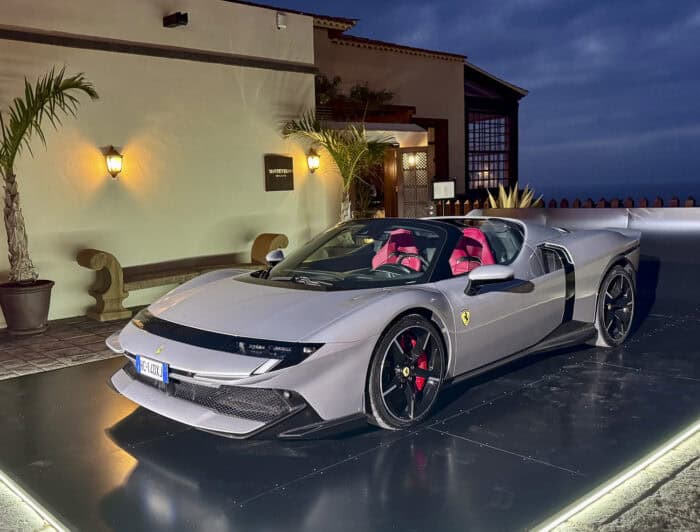
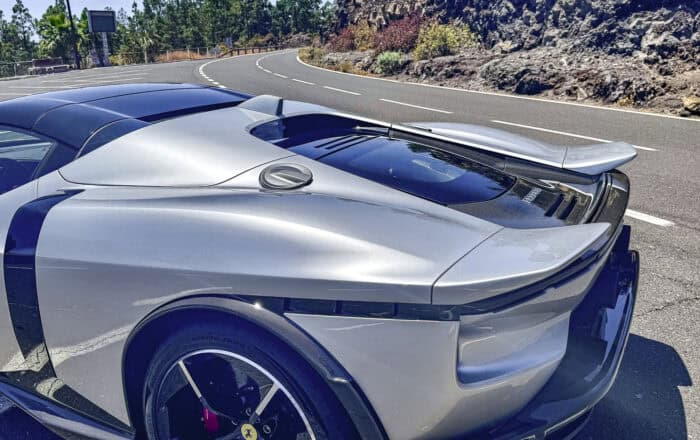
The design is just as theatrical as the performance. Ferrari has created what amounts to an Italian muscle car, with the broad shoulders, horizontal forms and aggressive proportions of a 1970s exotic. The company points to its Sports Prototype racers, including the 512 S and 512 M, as inspiration for the twin-tail rear treatment and geometric bodywork.
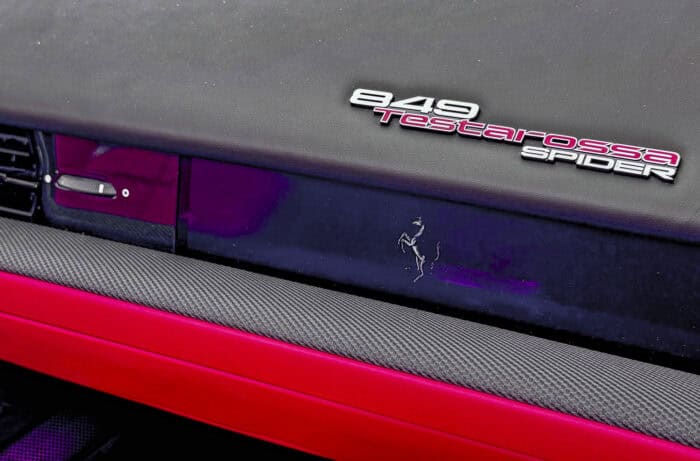
The name adds another layer of history: “Testa Rossa” first appeared on Ferrari racing cars in the 1950s before “Testarossa” became one of the defining road-car names of the 1980s. The new Spider connects eras that run from La Dolce Vita glamour to Miami Vice excess, then adds a plug-in hybrid powertrain, torque vectoring, brake-by-wire technology and sophisticated electronic controls.
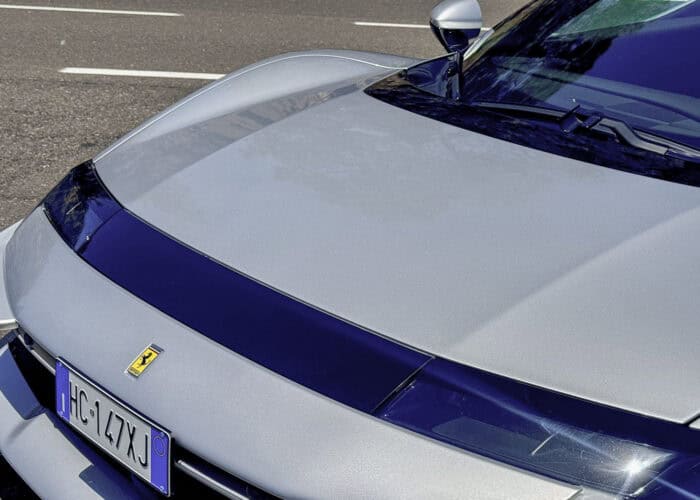
It’s a throwback vehicle wrapped around a 21st-century brain.
The public reaction suggested Ferrari got the balance right. At one point, I stopped to reconnect the route-navigation phone in a parking lot. When I looked up, cars had stopped around the Ferrari and people were taking photos and videos, gesturing excitedly.
Takeaway: Restraint Is the Real Challenge


Pros
- Explosive hybrid performance
- Surprisingly easy to control
- Dramatic, retro-futuristic design
Cons
- Far too much car for public roads
- Expected to cost a fortune
- Limited electric-only range
That may be the clearest verdict on the 849 Testarossa Spider. It looks like something remembered from a more outrageous age, yet it drives with a level of control that belongs entirely to the present. The challenge is remembering that the road, unlike a video game, remains stubbornly real.
Pricing for the 2027 Ferrari 849 Testarossa Spider in North American spec has yet to be announced; models aimed for the European market reportedly start at €500,000.