
You know what’s a very bad idea in the car business? Standing still. Which Tesla has admitted is their “strategy” to both their customers and shareholders. They’re axing models and doing zilch to advance their wobbly three-legged stool of the Model 3, Model Y, and Cybertruck. That’s the kiss of death for any carmaker, let alone one that’s being dragged down by the exact opposite of brand equity.
It’s also worse than even that. As Tesla tries to sell us on the idea of autonomy and robots, brands with mega customer loyalty, Toyota and Honda, are about to drop totally new products into the pipeline. And these are both brands whose customers have been clamoring for them to jump into the EV fray. So you’ll see innovation and new-ness from two leading carmakers known for just that—and for legendary quality. Plus, if you want quirkier, Subaru is also arriving with its own wares (twinned in production with two of three new Toyota EVs).
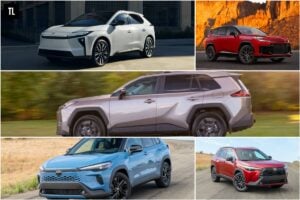
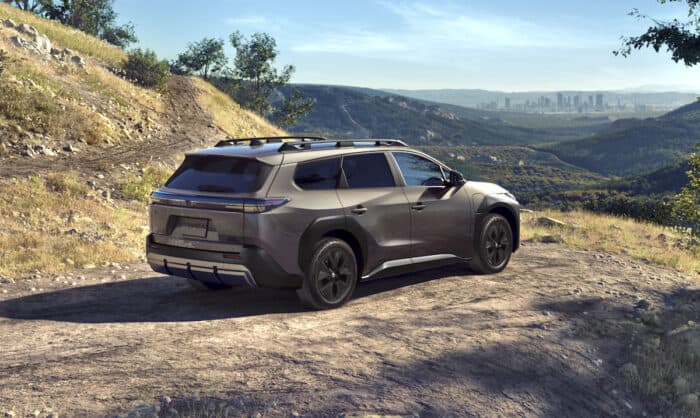
Not just that, but at least in the case of Subaru and Toyota, the products they’re launching fit into two niches where EV customers have had almost no options: Affordable, compact and fast (in the case of the forthcoming Toyota C-HR and Subaru Uncharted twins) and off-road-worthy and roomy—and also not too pricy—in the case of the Subaru Trailseeker and bZ Woodland.
How the bZ Woodland Hits the Sweet Spot
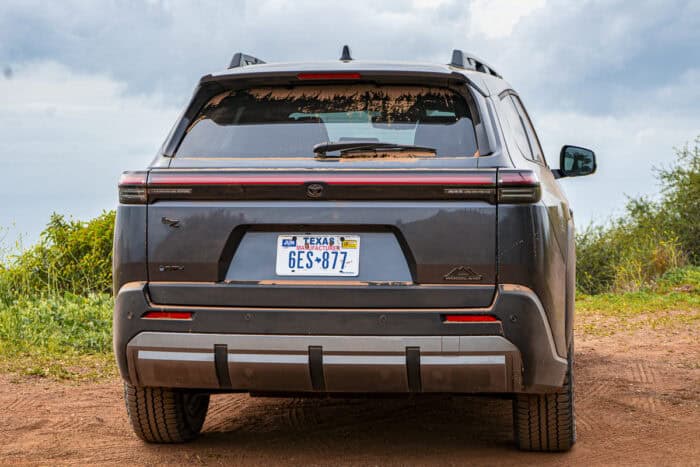
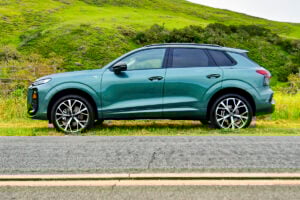
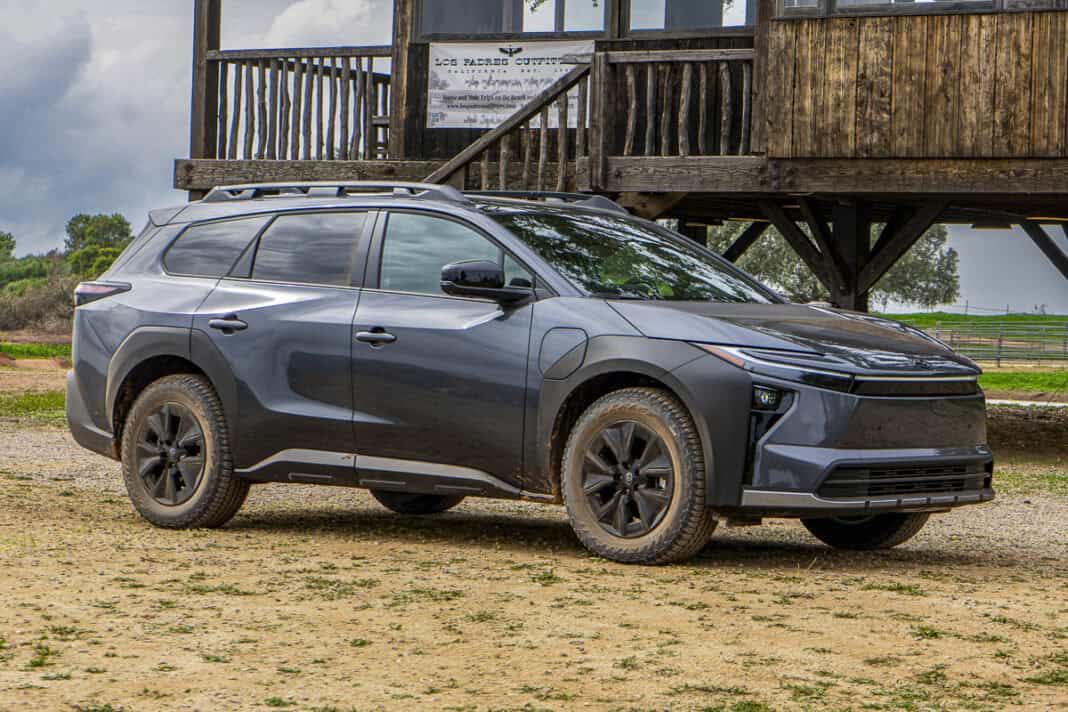
Next month you’ll be able to buy Toyota’s new bZ Woodland. Yes, the bZ (er, bZ4X) existed before. But let’s call that what it was for Toyota: a placeholder EV while the carmaker prepped itself for a more mainstream phase of EV production. The bZ Woodland is an entirely different animal. Just consider the stats:
- Up to 74.9-cubic feet of rear cargo capacity behind the front seats.
- 8.4 inches of ground clearance; par or better than a lot of rival SUVs
- Up to 3,500-lb towing capacity
- DC fast charging from 10-80 percent in roughly 30 minutes
- All-wheel drive with 375 horsepower
- An EPA-rated 281 miles of maximum range
- $45,300 starting price
- Subaru’s X-Mode off-road capability
Ticking through a few of these, 375 horsepower and 396 lb ft of torque, Toyota says, will be strong enough to deliver a 4.4-second 0-60 time. That’s roughly on pace with a Tesla Model Y. But forget that bogey: Toyota’s real goal is cleaving off buyers interested in legions of midsize gas crossovers. FYI, mostly, you’re spending the same $45,000-$55,000 in that world and, mostly, you’re not going to find anything as versatile as the bZ Woodland at this price tier.
Related – Toyota Built a 2026 RAV4 for Weekends, Not Just Commutes
And in fact, a lot of what you will find doesn’t have the generous 35.3 inches of rear legroom of the Woodland, and often you won’t see as much cargo volume, either. Toyota’s own Crown Signia, which sells for just about the same dough, comes up shy of the bZ Woodland on max cargo capacity, ground clearance, horsepower, and acceleration.
Pick a more obvious off-road-ish alternative, like the Honda Passport Trailsport and you’re just about matching ground clearance (8.3 inches), and besting both cargo (83.8 cu. ft.) and rear legroom—but the starting sticker scrapes over $50k. Also, the Honda is slower and far less poised on pavement.
And while the Passport is a vehicle I personally think sits on the rational side of the off-road worthy grocery-getter ledger, the now-gutted U.S. Environmental Protection Agency still says you’ll spend $2,200 a year fueling the Honda vs. just $650 plugging in the Toyota. Or, more starkly, $3.67 per 25 miles vs. $1.08 with the Toyota.
Skip The Chunky Tires
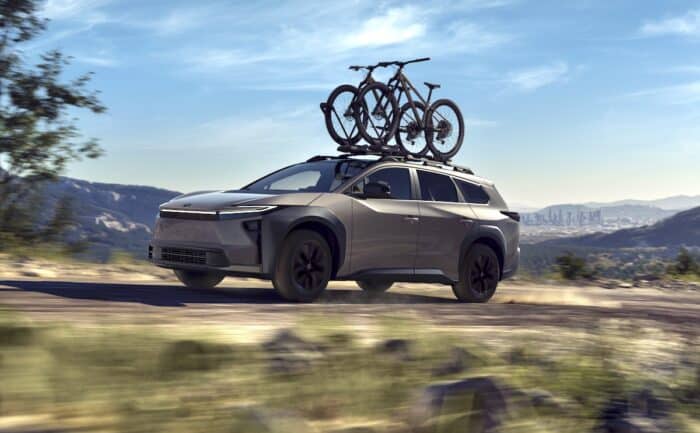
Car scribblers have certain advantages vs. the average consumer. I don’t mean because we’re opinionated jerks. (We can be.) I mean because those opinions are formed through our constant exposure to vehicles.
In the case of EVs, one thing you’ll see the public fear is limited range. That’s understandable. For instance, it may not be obvious why range falls off from 280 to 261 if you order the bZ Woodland with optional all-terrain tires (available in both base and Premium trims).
We’ve seen this before in other EVs with optionally larger tires. That alone increases rolling resistance. Go with meatier rubber, and the larger tread blocks increase drag. Guess what? This isn’t an EV thing. Any car fitted with larger tires will also see fuel economy fall.
Also, replacing those tires will cost you more and you’re going to hear them more when you (let’s be honest) mostly don’t drive on dirt. If you must, get them. But my advice is that most buyers just don’t off-road seriously enough to need that tread.
One Very Smart Feature
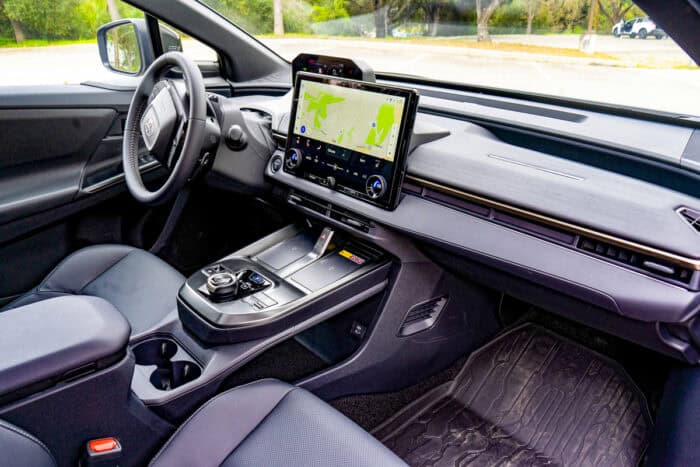
Toyota’s not screaming about it, but I’d definitely consider the Premium trim of the bZ because it includes an ingenious tech feature: radiant heating. This basically bounces infrared waves at the front passengers’ lower legs and feet. That matters, not just for comfort, but for real-world range.
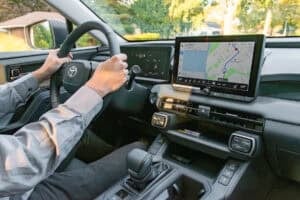
Yes, both tiers of Woodlands come with an excellent feature suite, including both front and rear seat heaters, a 14-inch touchscreen infotainment system (six speakers base/nine speakers Premium) and both wireless Apple CarPlay and Android Auto, and you get standard roof rails across the board, and a glass panoramic roof in the Premium trim. But the reason you may see superior range in the Premium trim is that Toyota’s learned that radiant heating is far more efficient for warming a cold cabin vs. heating the air floating out of the vents. Less energy loss to heat the interior allows greater range.
Also, there’s zero delay for radiant heating delivery, so you’ll feel toasty sooner than even in a gas car.
Bonus
While it’s not the same as true V2L (a.k.a., running your home’s appliances during a power outage), all bZ Woodlands have the capability to output 1500W of power. That’s plenty for tire inflators, running the entertainment at a tailgate or campsite, and also operating small campsite devices like electric coffee makers or hot plates.
Takeaway: Subaru Costs Less—Kinda
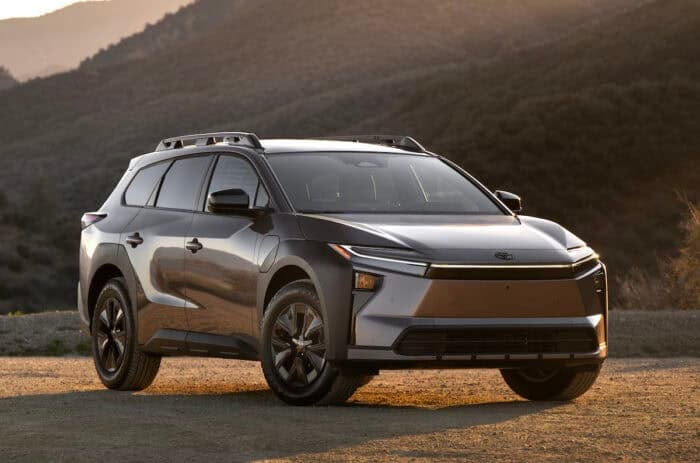
If you’re weighing whether to vote Subaru Trailseeker vs. bZ Woodland, one deciding factor is likely going to be price. And with a starting sticker of $39,995, Subaru is coming in with a much more affordable starting base. However, the bZ Woodland brings serious Subaru energy, and some of the base-level features on the Toyota can’t be had on the Subie until you’re at about par on price. At $46,555, the Trailseeker finally packs in front-and-rear seat heating and infrared heating, plus a panoramic glass roof.
Restrain yourself to none of those goodies, and the Trailseeker remains the more affordable choice, one that still offers a bunch of attributes EV buyers haven’t had until right now. And even the bZ Woodland feels agnostically wise, because it’s cost-competitive with gas alternatives and will save you yet more scratch in the long run.
A.K.A., we’ve finally reached the EV tipping point, where the rational, economically smart choice is buying electric.