

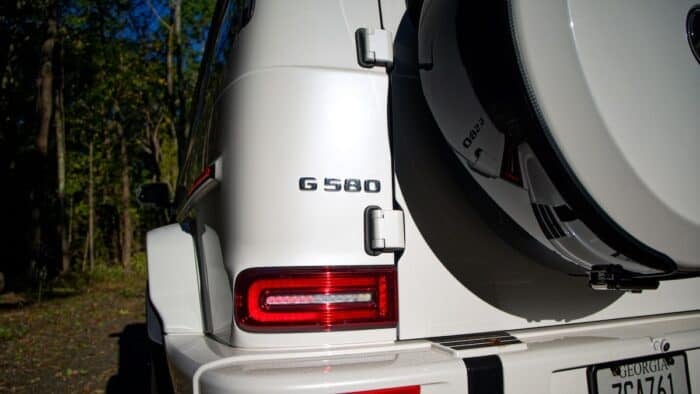
The electric G-Wagen is officially called the G 580 Electric SUV with EQ Technology. Nobody will ever call it that. They will call it fast, probably elegant, and unfortunately made for a fraction of the one percent. And no, that’s not because the spec I tested went out the door for $174,200.
At that price, I fear this person lives at such an elite level that they’re immune to the price of gas and won’t see the appeal and just purchase the gas version. That’s the unfortunate part, because if you’re cross-shopping at this tier, the G 580 has a lot going for it that the “more affordable” Rivian R1S quad, despite its lower $121,990 price and astonishing 1,025 horsepower powertrain, doesn’t equalize.
First, there’s pedigree. For a certain crowd, the G-Wagen signals a kind of horse-country-Ralph-Lauren-ranch chic that will take a very long time for Rivian to magic into existence. The tech-y person will of course appreciate Rivian for what it is, and no shade at all to how quickly they’ve fashioned their own (anti-Tesla) following. I appreciate Rivian’s consumer-first responsiveness and its focus on innovation over hidebound carmaker stuck-ness. It’s absolutely what the car business needs.
“Older G-Wagens had the numb steering and remote, unnerving handling of U-Hauls. Yeah, they looked bad-ass, but they felt like airport shuttle vans.”
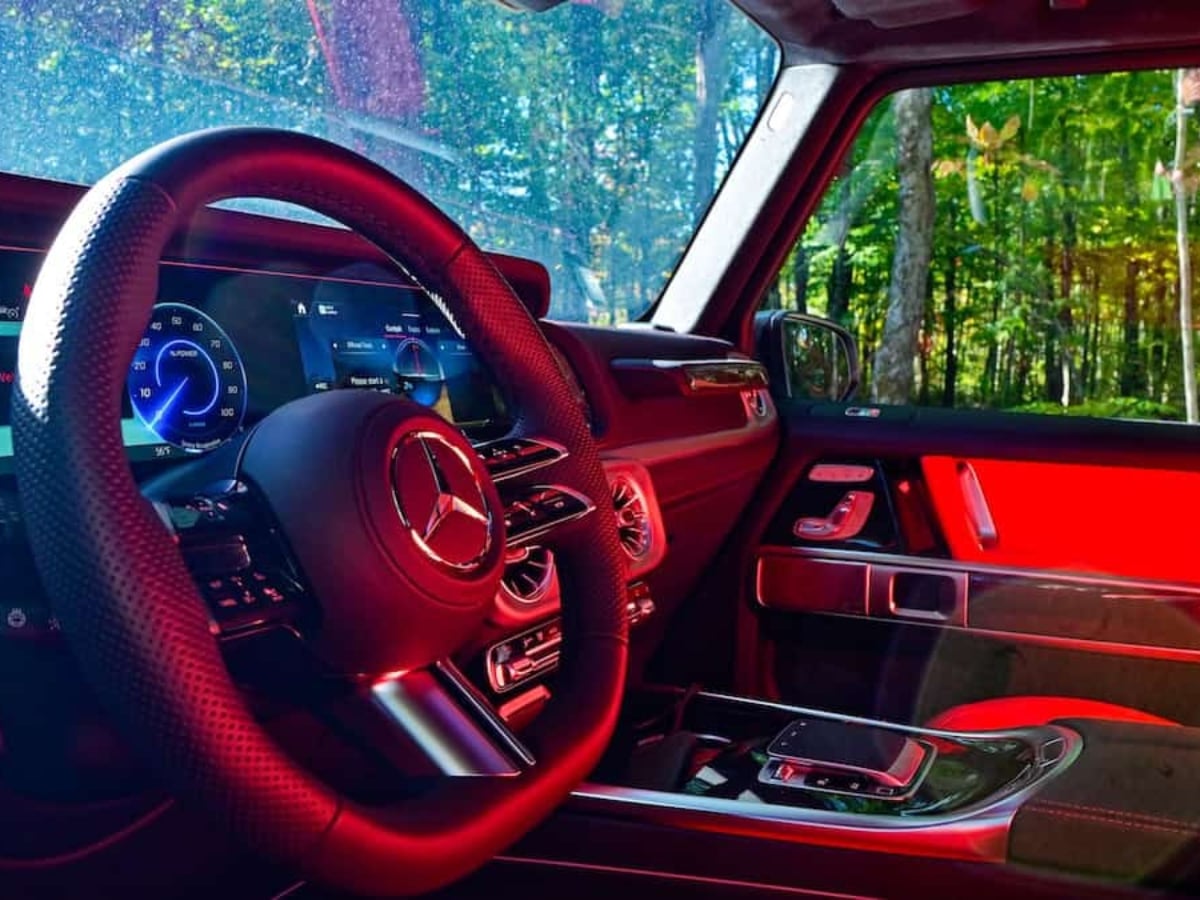
That said, look at this Benz’s acres of leather, the chunkiness of the door levers, and the Easter eggs everywhere, constantly reminding you that you’re in a German fortress of luxury.
Related – Chat With Explorer Mike Horn About His Epic Adventures & Role as Global G-Class Ambassador
Performance: Four Electric Motors — No Waiting

- Engine: Two permanent-magnet motors, 145 hp; two rear permanent-magnet motors, 145 hp
- Power: 579 hp
- Drivetrain: 4WD
- Max towing: 7,000 lb
I took a friend for a spin in the G 580. He marveled at the smooth ride, which uses adaptive damping and will firm or soften according to driver preferences via the “dynamic select” toggle near your right knee. At one point he asked me to floor it and I obliged and he practically had a heart attack. With four motors and 579 horsepower — and especially 859 pound-feet of torque — you’ll find your way to 60 MPH in about 4 seconds. That’s nothing to sneeze at, but it’s nowhere near as fast as the 2.6 seconds claimed by Rivian with their R1S with quad motor. But as EVs go, the G 580 feels faster because you sit so high, so the sensation of acceleration hits you like you’re on a stand-up amusement-park ride.
“It all feels like a big old hug of analog. Yes, there’s plenty of tech, but you can just dip a toe here and there to access functions you need and never bother with more than that.”
To me, it’s more remarkable that Mercedes-Benz can engineer the G 580 to drive so comfortably on the Interstate. Older G-Wagens had the numb steering and remote, unnerving handling of U-Hauls. Yeah, they looked bad-ass, but they felt like airport shuttle vans. All of that has been vanquished. The G 580 drives as posh as its price tag — and when you want, it’ll go like a bat out of Stuttgart. (Technically, Graz, Austria is the home of the G-Wagen, but why quibble?)
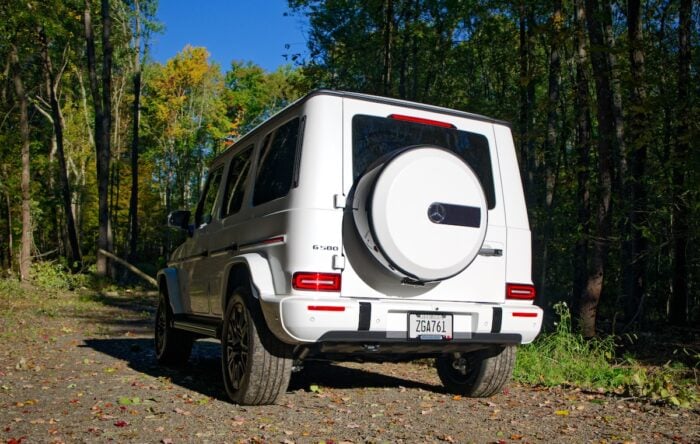
It’s also worth mentioning that, like the Rivian, the G 580 has exceptional off-road capabilities. It has just shy of 10 inches of ground clearance; a carbon plate protects most of the undercarriage from rock scrapes; it can ford water as deep as 34.8 inches; and Mercedes-Benz says you can tackle side slopes as steep as 35 degrees, plus the approach (32 degrees) and departure (30.7 degrees) are also quite impressive. Though, with its air suspension able to lift the R1S to 15 inches of ground clearance, that U.S.-built rig’s 35.8 approach/34.4 departure are superior. Do I think this buyer knows or cares about this stuff? Nope.
Interior: Very Slick, But Not as Capacious as it Looks
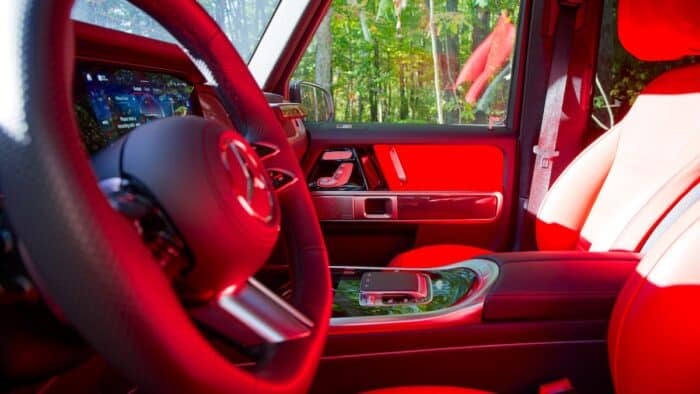
One reason to want this Benz vs. the Rivian is that it allows full phone pairing with either Apple’s CarPlay or Android Auto. Rivian has shunned these co-labs, and they also opt for unique thumb controls for a lot of functions and bury more in the touchscreen.
I prefer Mercedes’ combination of native tech, straightforward physical buttons for climate functions, and almost cartoonishly oversized and meaty surface treatments, from planks of carbon fiber to mines’ worth of metal bracing the doors. It all feels like a big old hug of analog. Yes, there’s plenty of tech, but you can just dip a toe here and there to access functions you need and never bother with more than that. Isn’t just that kind of choice the actual definition of luxury, not forcing me to adjust my brain to your tech-engineer-bro wizardry just to turn on the A/C?
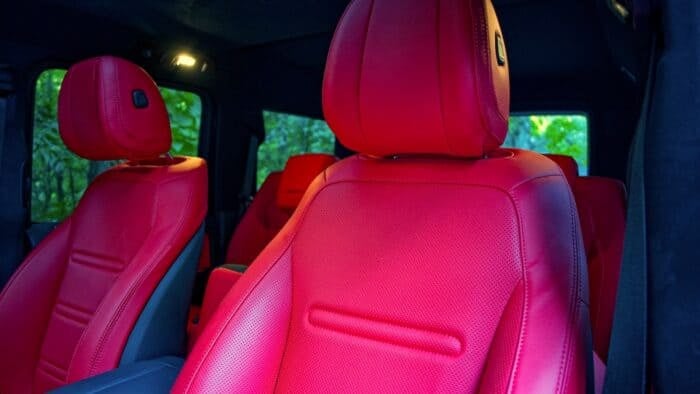
Then again, the G 580 may look huge from the outside (it’s actually 18 inches shorter than the R1S), but it’s not huge on the inside. Both the Rivian R1S and the G 580 have a decent, near 40 inches of rear seat legroom, so you can comfortably bring four full-sized adults. But if they have baggage, the Rivian’s roomier, with 58 cubic feet of capacity behind the second row and 84.7 cubic feet of maximum room. The G 580’s max is 70.3 cubic feet, which is adequate, but with only 34.8 cubes behind the second row you’re in Honda CR-V territory. I know that’s not where this buyer’s shopping, but you get the picture.
Styling: It’s Dressed to Impress

I don’t think there’s any question that the electric G-Wagen looks super impressive. It’s not hard to be a fan, and in this tier of near-supercar electrics, along with Lucid, there’s really nothing else on the road that stands out like this Mercedes. When Scout arrives, they’ll draw customers looking for the combination of tech and nostalgia, too, and — probably— fewer poseurs. On that front, of course that’s beside the point. I see far more Land Rover Defenders crawling the pavement of New York City than in my own neck of bumpkin-land that at least has some actual dirt — usually prowled by dudes in Tacomas. Still, the G 580’s aesthetics certainly work great, and in part because it’s not trying to “look” like an EV.
Takeaway


You’re waiting for a hedge, right? Here’s one: Range. The EPA says the G 580 can travel 239 miles between charges, and the R1S can go 338. That’s a big difference. And the Benz’s charging speed is pretty pokey, especially for a vehicle targeted at Gucci-heeled buyers, with a 10-80 percent charge taking 32 minutes at a max rate of 200 kW. A Lucid Gravity Grand Touring has a range of 450 miles, and Lucid says you can add 200 miles of range in just 15 minutes at a max rate of 300 kW.
I fully expect this buyer will mostly charge at home, but if you want the rich to care enough to buy electric you have to coddle them. Making them twiddle their thumbs while charging — and have to charge more frequently — is definitely a tough sell.
Pros
- Insanely attractive, both inside and out
- Legit off-road capability
- Whisper-quiet operation and very brisk acceleration
Cons
- Weak range vs. competition
- Somewhat limited luggage space