
We regularly review this guide to keep model details, specs and availability current for U.S. and Canadian buyers. Last updated October 2026.
Hyundai’s SUV lineup is getting crowded, and that’s before you count the different ways to power them. From the city-sized Venue to the family-hauling Palisade, there’s a mix of gas, hybrid, plug-in hybrid and electric options, plus the hydrogen-powered NEXO doing its own thing. We’ve lined up the eight model families from smallest to biggest, including the next-gen 2027 Tucson, to help you figure out which one fits. U.S. and Canadian specs are covered, with the differences pointed out where they matter.
Hyundai Venue (Subcompact Crossover SUV)
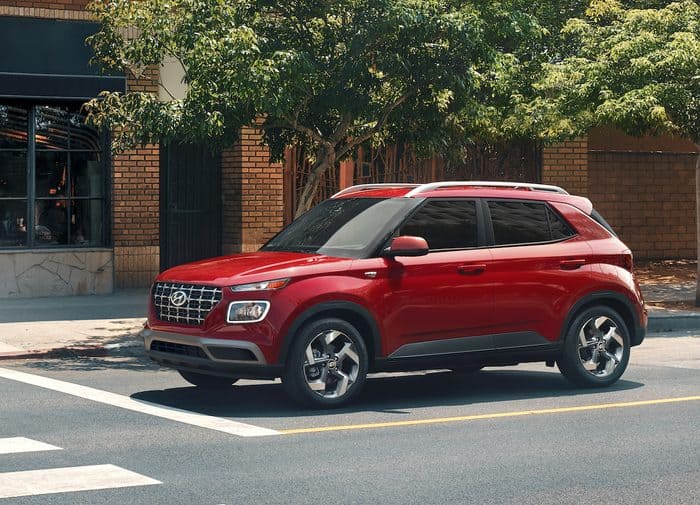
Definitely the oddball of the bunch, but Hyundai’s smallest SUV keeps things simple: five seats, front-wheel drive, and a footprint that makes city parking easy. The Venue uses a 1.6L four-cylinder producing 121 horsepower and 113 lb-ft of torque, paired with Hyundai’s Intelligent Variable Transmission. U.S. models return an EPA-estimated 31 mpg combined, and there’s no AWD option in either market. It’s the entry point for buyers who want the upright seating and useful cargo area of a small crossover without stepping up to a larger SUV. Canadian models share the 121-hp engine, with Essential, Preferred and Ultimate trim names rather than the U.S. SE and SEL-based lineup. Choose the Kona if rear-seat space, AWD or stronger performance matters more.
Hyundai Kona (Subcompact Crossover SUV)

The second-generation Kona is the next step up from Venue, bringing more passenger room and available AWD while staying easy to live with in the city. U.S. gas models offer a 147-hp 2.0L four-cylinder with 132 lb-ft of torque or a 190-hp 1.6L turbo with 195 lb-ft. The turbo pairs with an eight-speed automatic. Canadian buyers also get the sportier Kona N Line, which adds more aggressive styling to the turbo model; it shouldn’t be confused with the discontinued high-performance Kona N.
The Kona Electric stays under the same umbrella, but model years and range differ by market. Hyundai’s U.S. listing remains the 2025 model: EPA-estimated range is 200 miles for SE, 261 miles for SEL/Limited and 230 miles for N Line. Canada lists a 2027 Kona Electric with up to 420 km of range. The EV is front-wheel drive, so buyers wanting AWD need the gas Kona or a larger Hyundai EV.
Hyundai IONIQ 5 (Electric Compact Crossover SUV)

The IONIQ 5 pairs its pixel-inspired styling with a flat-floor cabin and quick charging, giving Hyundai a roomier electric option than Kona. For 2026, U.S. versions offer 63-kWh or 84-kWh batteries, rear- or all-wheel drive, and an EPA-estimated maximum range of 318 miles in long-range RWD form. The long-range AWD model makes 320 horsepower and 446 lb-ft of torque. Canada’s current 2027 lineup lists standard AWD and up to 463 km of NRCan-rated range, so the U.S. RWD figure doesn’t apply across the border.
The IONIQ 5 XRT adds a suspension lift and all-terrain tires, while the IONIQ 5 N delivers up to 641 horsepower with N Grin Boost. Regular refreshed models gain a rear wiper (much needed!) and NACS charging port. U.S. models quote about 20 minutes for a 10–80% charge on a suitable 350-kW CCS charger with an adapter; Hyundai Canada advertises as little as 18 minutes.
Hyundai Tucson (Compact Crossover SUV)
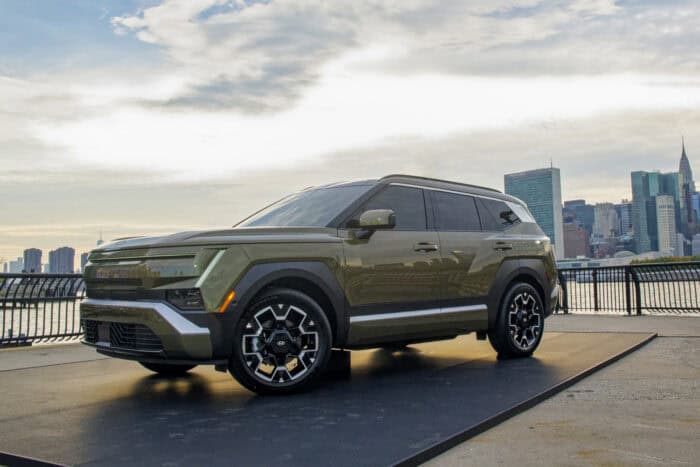
The redesigned 2027 Tucson gives Hyundai’s main compact SUV a bigger body, sharper Art of Steel styling and a completely reworked cabin…taking the fight Toyota’s new RAV4. It stretches to 185.0 inches (4,700 mm), with a longer wheelbase and Hyundai targeting 41.7 cu. ft. of cargo space behind the second row. Announced U.S. outputs are 184 horsepower for the 1.6L turbo gas model and 233 horsepower for the hybrid. Hyundai targets up to 42 mpg for the front-wheel-drive hybrid on 17-inch wheels; that’s a development target, not a final EPA rating.
Inside, the new Pleos Connect system brings Android Automotive-based infotainment with an available 17-inch touchscreen. The XRT Pro adds extra ground clearance and terrain-focused technology for buyers who want more than rugged styling. North American arrivals are scheduled for 2027, with Canada specifying early 2027 and confirming gas and hybrid options; final Canadian output and fuel-economy figures still need local confirmation. The outgoing Tucson also offers a plug-in hybrid, but Hyundai’s new-generation PHEV announcement is for select markets. Its global range figures shouldn’t be treated as confirmed U.S. or Canadian specifications.
Hyundai NEXO (Hydrogen Fuel Cell SUV)

The NEXO is Hyundai’s unusual alternative to a battery EV: its fuel cell generates electricity from hydrogen, so you refill a tank instead of plugging it in. U.S. buyers have known it as a California-focused model, with the earlier NEXO rated for up to 380 miles of EPA-estimated range. The redesigned second generation grows to 187.0 inches (4,750 mm), bringing Art of Steel styling and a more modern cabin with a 12.3-inch infotainment screen, over-the-air updates and available Bang & Olufsen audio.
For the 2026 NEXO, Hyundai Canada lists 201 horsepower and approximately 711 km of range, but that range is an internal estimate, not an NRCan rating or a U.S. EPA figure. Canadian availability is fleet-only, with no regular retail sales. Hydrogen-station access remains the deciding factor in either country, making NEXO a much more specialized choice than Kona Electric or IONIQ 5.
Hyundai Santa Fe (Mid-Size 3-Row SUV)

The Santa Fe is where Hyundai’s lineup moves into three-row family duty, with a boxy shape, broad liftgate and six- or seven-passenger layouts depending on trim. U.S. 2026 models offer a 277-hp 2.5L turbo four-cylinder with 311 lb-ft of torque, or a 231-hp 1.6L turbo hybrid. The gas model uses an eight-speed automatic; the hybrid gets a six-speed. U.S. hybrid ratings reach 36 mpg combined with FWD or 34 mpg with AWD, making it the more efficient choice for everyday family use.
Canada’s 2027 lineup takes a different approach, listing the 231-hp hybrid as standard rather than mirroring the U.S. gas-and-hybrid selection. Available captain’s chairs, dual 12.3-inch displays and premium cabin finishes broaden the appeal beyond its outdoorsy look. Our Santa Fe Ultimate Calligraphy review takes a closer look at that cabin; the Santa Fe XRT review covers the rugged gas model.
Hyundai IONIQ 9 (3-Row Electric SUV)
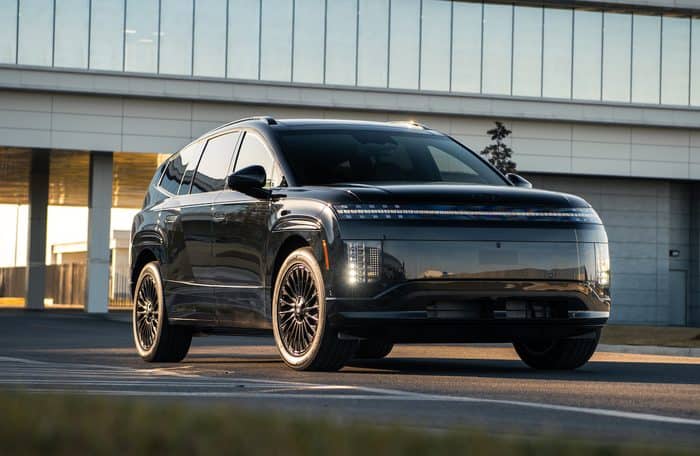
The IONIQ 9 is now part of Hyundai’s lineup, giving families a three-row electric alternative to Palisade. Every U.S. 2026 version uses a 110.3-kWh battery: the 215-hp RWD S delivers an EPA-estimated 335 miles, 303-hp AWD SE/SEL models reach 320 miles, and 422-hp AWD versions are rated for 311 miles. Canada advertises up to 539 km for the RWD model, based on manufacturer testing. Its 199.2-inch (5,060-mm) body and long wheelbase put it among Hyundai’s largest SUVs, with six- or seven-passenger configurations depending on trim.
The flat-floor cabin focuses on family space, with available relaxation seats and a sliding centre console. An NACS port supports compatible Tesla Superchargers, while 800-volt charging can take the battery from 10–80% in about 24 minutes on a suitable 350-kW CCS charger with the included adapter. That’s a best-case charging time, rather than a promise for every public charger.
Hyundai Palisade (Mid-Size 3-Row SUV)
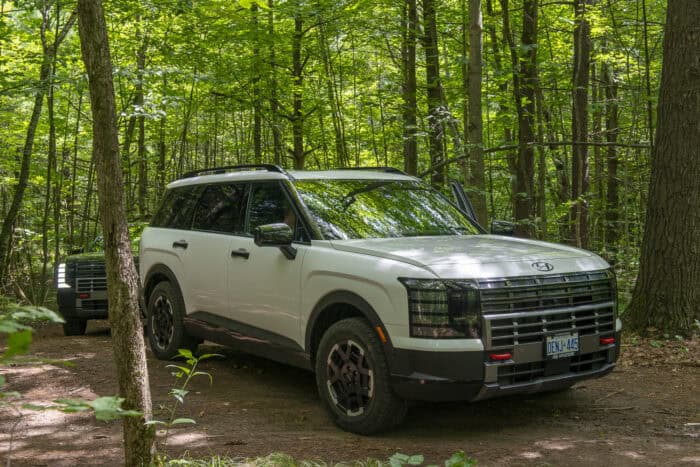
Redesigned for 2026, the Palisade remains Hyundai’s largest gas or hybrid family SUV, with seating for seven or eight. U.S. buyers can choose a 287-hp 3.5L V6 or a 329-hp 2.5L turbo hybrid, the latter producing 339 lb-ft of torque. Selected FWD hybrid trims reach an EPA-estimated 34 mpg combined. Canada also offers V6 and hybrid versions, with AWD across the lineup and different trim packaging, including Ultimate Calligraphy.
The Palisade lineup ranges from practical family transport to the upscale Calligraphy and rugged XRT Pro we recently tested out in the wild. XRT Pro adds all-terrain tires, 8.4 inches of ground clearance and an electronic rear limited-slip differential. Most trims measure 199.2 inches long, essentially matching IONIQ 9, while XRT Pro reaches 200.4 inches. Properly equipped V6 models can tow up to 5,000 lb; hybrids can tow up to 4,000 lb when properly equipped.
Shopping for a Hyundai? Check out all our Hyundai reviews here.