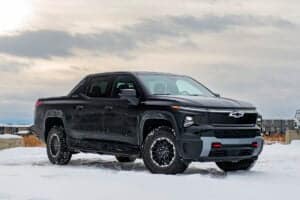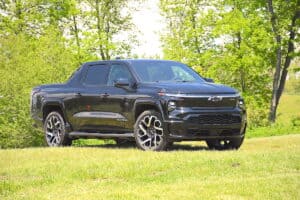

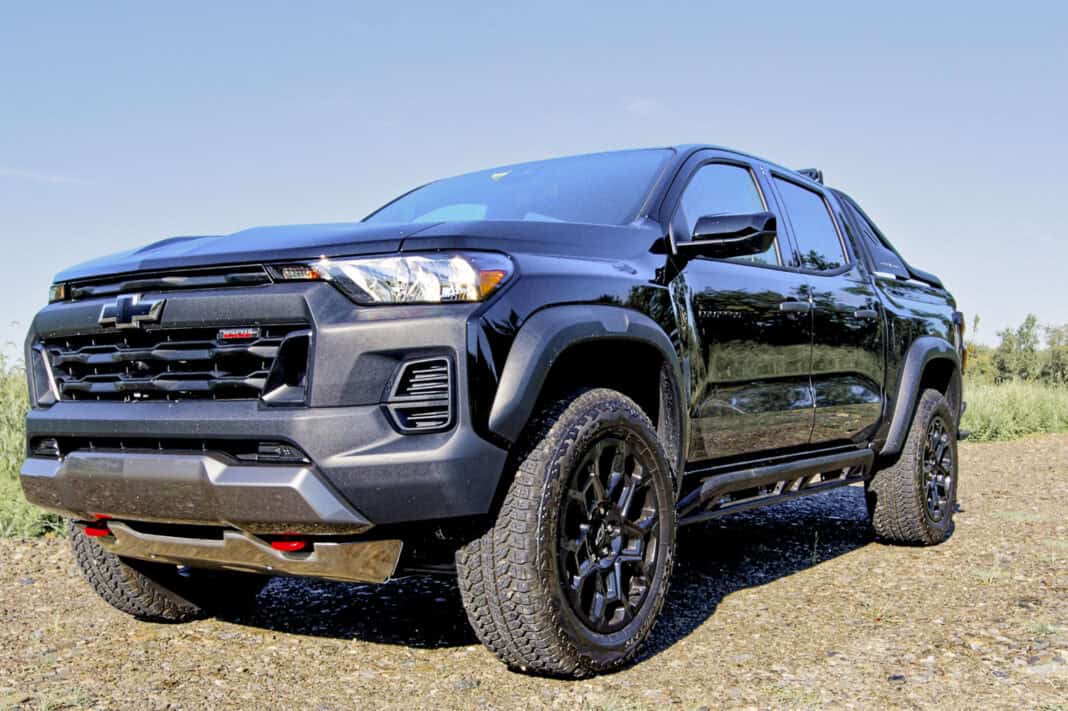
I often wonder what a carmaker is thinking when they loan out an ink-black press car. They clearly don’t want the media to photograph it, because black cars are giant mirrors.
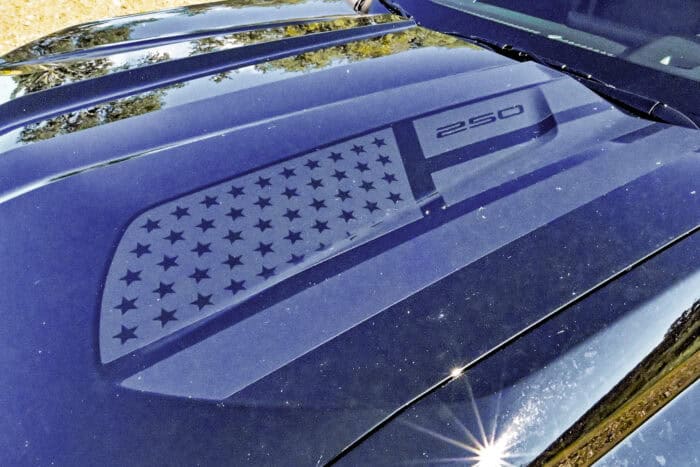
This one gets graced with a “Stars and Steel” special edition package for a painful $13,455 added to the $42,500 base price (including destination). This includes an etched stars-and-bars scheme on the hood, a sports bar in the bed with its own accessory light bar, and more signage to show off your patriotism. To each their own, but I would much rather customize my whip with a one-of-one scheme, and you could surely save a lot of money going that route. Squint, though, and focus on the functional elements like the standard lift kit the Trail Boss gets and you can see it makes a very viable alternative to the uprated versions of the Tacoma—for way less dough.
Related – Chevrolet Colorado Vs. Toyota Tacoma: A Battle of Power & Price
Performance: The Trail Boss Balances Comfort and Capability
- Engine: 2.7L turbocharged I-4
- Power: 310 hp
- Drivetrain: 4WD
- Max towing: 7,700 lb
The Colorado has an asset that lots of mid-sized trucks don’t and it’s why the number two truck in this category isn’t a truck at all, it’s the Ford Maverick, which rides on a unibody chassis. Ford’s selling those at double the clip of the Colorado. Heck, nearly 2.5 Mavericks sell for every Ranger. And the “why” here is ride quality. The Colorado’s is pretty good in this department, with strong on-center feel to the steering. It’s not as glassy as the Maverick, but it’s actually a tad better than the Tacoma and I’d say on par with the Nissan Frontier, which has rapidly become a close competitor to the Colorado this year.
“If you got the ZR2 or the Trail Boss packages and skipped the shiny “Stars and Steel” livery, you’d save yourself over ten grand (or close to $20,000) vs. the Trailhunter.”
The Colorado is also easy to pilot; I noticed that while parking, but also on the Interstate. It’s a very pleasant truck to live with. It’s also pretty quiet, and its 2.7-liter powerplant never really drones or blasts its backbeat through the cabin. Oh, and FYI, next year the 2.7-liter I-4 will increase output above its current 310 horsepower. I don’t know by how much, but this is very likely the same engine upgrade coming to the Silverado, and GM officials confirmed the enhancement to me via e-mail. Sadly, without giving more details.
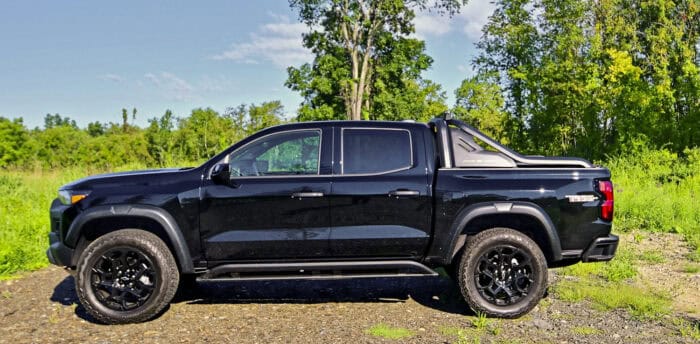
As for what’s available right now, the factory lift-kit of two inches raises the Trail Boss to 9.5 inches of ground clearance. There’s a stock two-speed transfer case, and robust skid plating and rock rails. That still pegs it 1.5 inches lower than the Trailhunter Tacoma — and I doubt it matters unless you rock crawl every weekend.
Related – 2017 Chevrolet Colorado ZR2 Review
Interior: A Comfortable Cabin With Some Questionable Choices
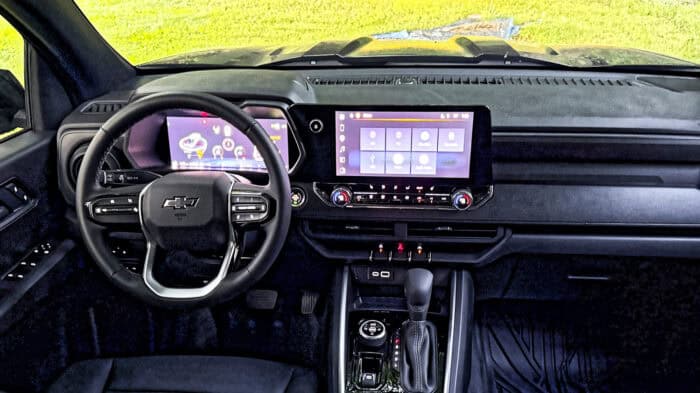
There are lows and highs here. On the high side, GM retains physical buttons for the HVAC controls, rather than nesting them in the touchscreen. But on the con side, a switch you really might want handy to control the headlamps is buried as an on-screen “button.” This kind of decision is genuinely baffling. Sure, a default automatic headlamp function is the norm these days, but being able to manually switch lights on and off quickly is actually a safety function, as is the ability to disable auto-high beam assist rapidly.
Another demerit: There’s a lot of hard plastic trim across the dash of the Colorado. It’s not horrid (and par for the class, by the way), and vent controls are at least spiffier, but this is where you’re seeing rivals in other classes, like five-seat crossovers, tweak the meter a bit more upscale.
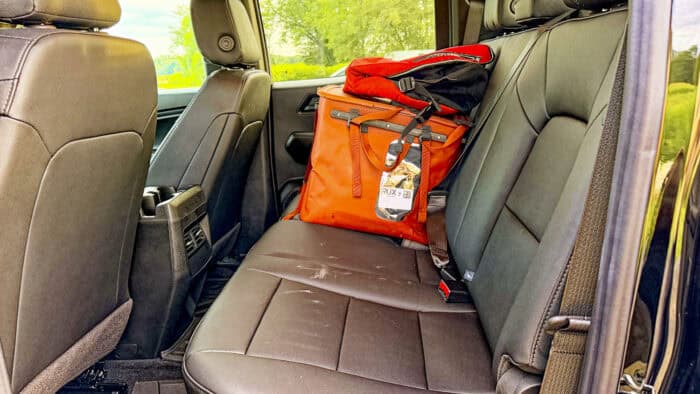
That said, the truck’s cabin is a perfectly functional environment, with, for instance, cupholders on every door, wireless phone charging and the driving position is excellent. I spent several hours at the wheel and never felt tired by the end of a drive, which means the seats are supportive and rear-seat comfort is also decent, which isn’t always a given in smaller trucks.
Related – Small Trucks Rise Up: Every New Midsize Pickup Truck You Can Buy
Styling: Skip the Graphics and the Colorado Looks Better for It
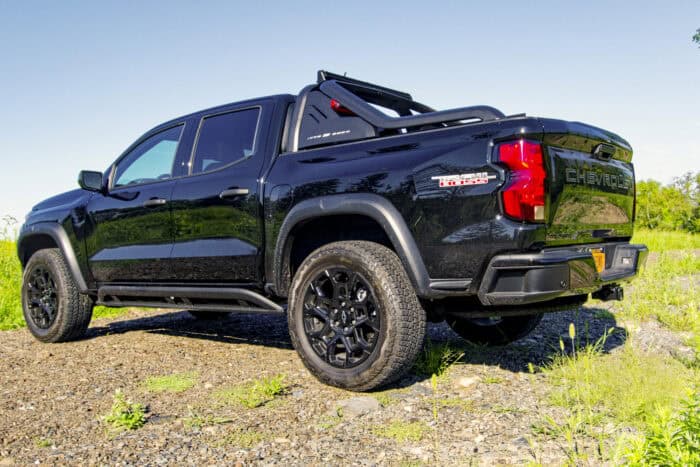
There’s a funny thing about the 250th anniversary package emblazoning this truck. It’s literally got 1776-2026 on the sports bar, which is a lot less subtle than the flag-themed hood. The average American vehicle is 12.7 years old. And unlike a VIN, this truck is going to be advertising its age forever. That’s like having a “best before” date on your truck. And like old baked goods, I fear it won’t be great for resale.
Presuming you skip this package, you’re getting a truck that plays the very best tune of ruggedness. In black it even looks sharp and decently special, without being an in-your-face poser, like the dude who decides to throw half-foot spacers onto his 4X4 so it rides a mile wide. (Which, FYI, is not exactly what you want for off-roading.) The Colorado avoids that brand of brashness and simply looks confident.
Takeaway
Pros
- Comfortable, composed ride
- Legit off-road capability
- Strong 7,700-lb towing capacity
Cons
- Stars and Steel package is pricey
- Too much hard cabin plastic
- Headlight controls buried onscreen
Through seven months of mid-size truck sales this year, the category might as well be called “Toyota Tacoma and Friends.” Toyota has sold more than three times as many Tacos for every Colorado. Ford’s Maverick, again technically not really a truck, is solidly in second place.
But if you need the legitimate capability of a mid-sized truck, especially up to 7,700 pounds of towing capability vs. a max of 4,000 pounds with the Maverick, buyers really should be cross-shopping this Chevy. If you got the ZR2 or the Trail Boss packages and skipped the shiny “Stars and Steel” livery, you’d save yourself over ten grand (or close to $20,000) vs. the Trailhunter.